
tirzepatide vs semaglutide
This is the cleanest way to understand the incretin classes: semaglutide is a single-receptor agonist, tirzepatide is a dual-receptor agonist. The comparison is about how many incretin receptors each engages — and where the research record sits. Veyvora supplies tirzepatide (and the triple agonist retatrutide); we do not stock semaglutide.
single agonist vs dual agonist
Semaglutide is a single GLP-1 receptor agonist — it engages one incretin receptor, the most-studied one in glucose-regulation and appetite research. Tirzepatide is a dual GIP/GLP-1 co-agonist: one molecule engaging two incretin receptors. That extra GIP arm is the whole difference between the two classes.
why the receptor count is the axis
Adding the GIP receptor doesn't make tirzepatide "a better semaglutide" — it makes it a different research tool, studied for what two incretin arms do together that one does not. Semaglutide's single-agonist record is longer and deeper; the dual-agonist class is newer. Which is the right comparator depends entirely on the receptor question being asked.
where the triple agonist fits
The progression is single → dual → triple. Retatrutide adds a third arm, the glucagon receptor, on top of tirzepatide's dual profile. For the dual-vs-triple step, see retatrutide vs tirzepatide.
what Veyvora supplies
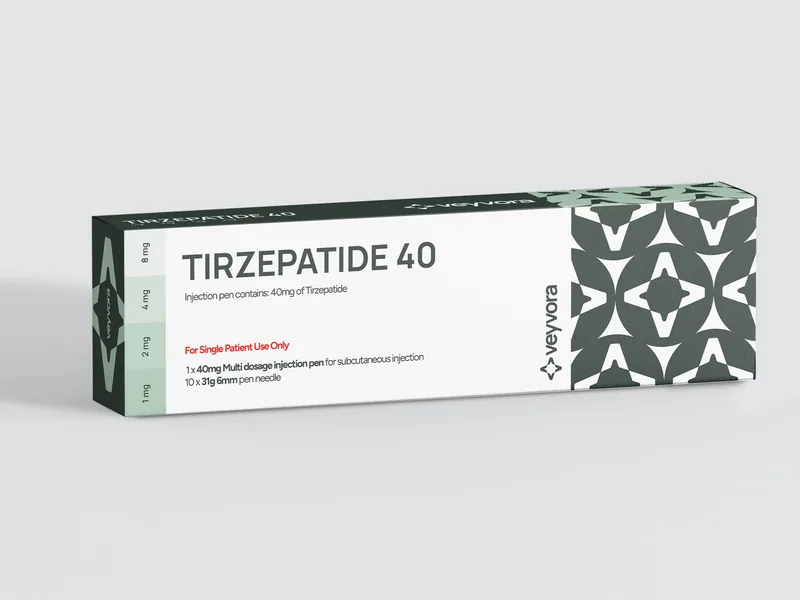
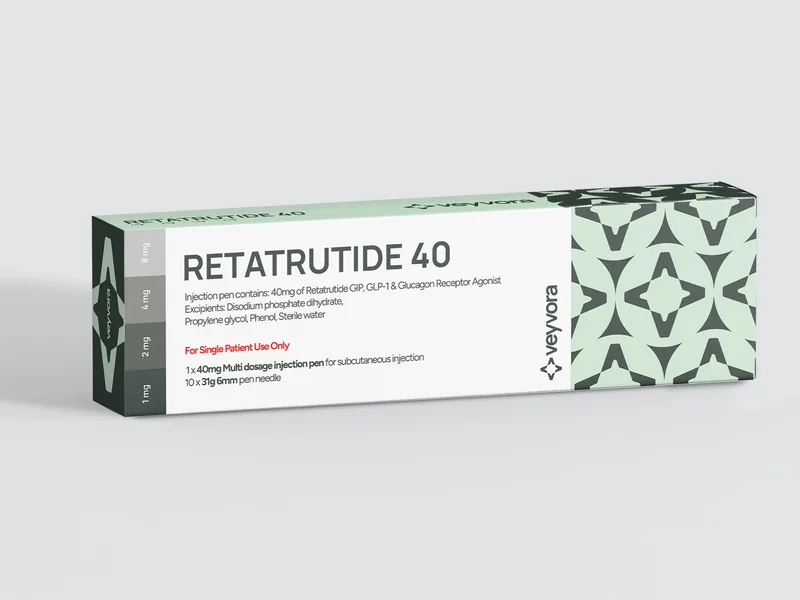
We stock tirzepatide and retatrutide as research pens, each pre-filled and independently assayed with a batch-specific certificate of analysis. We do not supply semaglutide — it appears here only as the single-agonist reference point. See how to read a CoA.
research use only
Both compounds are supplied strictly for in-vitro and laboratory research use only — not medicines, not for human or veterinary consumption. Nothing here is dosing, medical or treatment guidance.
the research pens
Pre-filled, batch-numbered and independently assayed. Save one to your list and we'll email you the moment it's available in your country.
Overview
Semaglutide is a single GLP-1 (glucagon-like peptide-1) receptor agonist; tirzepatide is a dual GIP (glucose-dependent insulinotropic polypeptide) and GLP-1 receptor co-agonist. Because their receptor coverage differs, the two molecules answer different mechanistic questions and are not interchangeable research tools, even though both belong to the incretin class. Veyvora supplies tirzepatide as a research pen but does not supply semaglutide; semaglutide appears on this page as the single-agonist reference class against which dual-agonist biology is compared.
This page covers three things: how the receptor profiles of tirzepatide and semaglutide differ and why that distinction governs protocol design; what the 2025 head-to-head trial data establish and where they stop; and what documentation checks are required before using any incretin research material.
All materials and discussion on this page are for laboratory and in-vitro research use only. Nothing here constitutes human treatment, administration or dosing advice.
Browse Veyvora’s tirzepatide research pen and request the batch CoA at veyvora.com.
Key Takeaways
- Tirzepatide engages two incretin receptors (GIP and GLP-1); semaglutide engages one (GLP-1 only). Selecting the wrong molecule makes it impossible to attribute observed effects to a specific receptor arm.
- The 2025 SURMOUNT-5 trial reported −20.2% mean body-weight change with tirzepatide versus −13.7% with semaglutide at 72 weeks [2], but those population-level figures do not validate any specific research batch or in-vitro assay condition.
- Semaglutide carries the more mature cardiovascular outcomes evidence as of 2026; the preferred molecule depends on the endpoint being prioritised, not on a single aggregate verdict [1][2].
- Every batch requires its own certificate of analysis (CoA) naming an independent external laboratory; supplier statements and peer-reviewed trial data are distinct categories of evidence.
- Veyvora supplies tirzepatide as a research pen. No verified live Veyvora semaglutide product page was available at the time of writing.
Direct Comparison
Differing receptor coverage produces endpoint-dependent consequences for protocol design. The 2025 SURMOUNT-5 randomised trial reported a mean body-weight change of −20.2% with tirzepatide versus −13.7% with semaglutide at 72 weeks, which illustrates that the choice of molecule determines which receptor arm the protocol interrogates [2]. Semaglutide retains the more established cardiovascular outcomes evidence as of 2026, so selecting between the two depends on which downstream pathway the protocol targets [1].
Before drawing procurement conclusions from any batch, researchers should verify a batch against its CoA and understand how to read HPLC purity results, since supplier documentation and independent assay evidence are distinct categories of proof.
| Property | Semaglutide | Tirzepatide |
|---|---|---|
| Receptor target | Single GLP-1 receptor agonist | Dual GIP/GLP-1 co-agonist |
| Molecular basis | Long-acting GLP-1 analogue | Modified 39-amino-acid peptide on GIP scaffold [6] |
| Incretin arms engaged | One | Two |
| Primary research use | Isolating GLP-1-mediated signalling | Modelling dual incretin biology |
| Cardiovascular outcomes evidence | More established as of 2026 [1] | Growing; 2025 head-to-head data available [2] |
| UK regulatory status (2026) | Licensed medicine (Wegovy, Ozempic, Rybelsus) [1] | Licensed medicine (Mounjaro) [1] |
| Supplied by Veyvora | No | Yes, research pen |
Identity and Mechanism Side by Side
Semaglutide is a long-acting GLP-1 analogue that selectively activates the GLP-1 receptor. Tirzepatide is a modified 39-amino-acid peptide built on GIP sequence features and engineered as a dual agonist at both GIP and GLP-1 receptors [6]. For the compound’s receptor pharmacology and research context, see tirzepatide research explained. That structural distinction governs protocol design: semaglutide is the narrower tool, suited to probing GLP-1-mediated effects such as appetite regulation, gastric emptying and glucose-dependent insulin secretion, while tirzepatide models dual incretin biology and cannot isolate GLP-1 signalling alone [6].
| Property | Semaglutide | Tirzepatide |
|---|---|---|
| Receptor target(s) | GLP-1 only | GIP + GLP-1 (dual) |
| Structural basis | GLP-1 analogue | Modified 39-aa GIP-based peptide [6] |
| Agonist class | Single | Dual |
| Primary research use | GLP-1 pathway isolation | Dual incretin interrogation |
| UK regulatory status (2026) | Licensed (Wegovy, Ozempic, Rybelsus) [1] | Licensed (Mounjaro) [1] |
| Veyvora supply status | Not supplied | Research pen |
A study asking whether GIP receptor engagement alters a phenotype requires tirzepatide or another dual agonist; a study isolating GLP-1 pathway effects fits semaglutide [6]. The two molecules are different research tools, not interchangeable versions of the same compound. Researchers whose protocols have moved beyond dual agonism towards triple-receptor coverage can consult the tirzepatide versus retatrutide comparison, and retatrutide’s triple-agonist mechanism explains the third receptor arm, the GCG (glucagon) receptor, without expanding this page into a separate comparison.
Batch-specific identity, purity, endotoxin status and receptor activity must come from that batch’s own documentation; supplier statements and independent assay evidence are distinct categories of proof [7].
Evidence Strength and Limitations
The comparative evidence base for tirzepatide and semaglutide is strongest for body-weight reduction and glycaemic endpoints. Researchers should not assume those findings extend to every downstream outcome a protocol might target.
What the Head-to-Head Trials Establish
The 2025 SURMOUNT-5 randomised trial reported a mean body-weight change of −20.2% with tirzepatide versus −13.7% with semaglutide at 72 weeks [2]. Network meta-analyses published in 2024–2025 broadly support tirzepatide’s advantage on weight and HbA1c (glycated haemoglobin) endpoints, though the evidence remains heterogeneous across cohorts and dose comparisons [2]. Semaglutide retains the more mature cardiovascular outcomes literature; a 2026 real-world analysis reported lower rMACE (major adverse cardiovascular events) risk with semaglutide than with tirzepatide in one claims cohort, which means the preferred molecule depends entirely on the endpoint being prioritised [2]. Reducing the comparison to a single verdict misrepresents the evidence.
Where the Evidence Thins
Outside weight and glycaemia, the published record for both molecules is considerably thinner. Receptor occupancy, second-messenger signalling, pathway bias and internalisation kinetics are more appropriate endpoints for in-vitro mechanistic work, yet head-to-head data at that level of resolution are sparse as of 2026. UK government guidance from 2026 confirms that both semaglutide and tirzepatide are licensed medicines for specified clinical uses, but explicitly states that use outside those licensed indications has not been assessed for safety or effectiveness by the MHRA (Medicines and Healthcare products Regulatory Agency) [1][7].
A commercial research batch inherits none of the clinical trial findings unless that specific batch has been independently characterised. Batch-level identity, purity and endotoxin status require the batch’s own CoA; peer-reviewed trial data cannot substitute for batch documentation. Researchers sourcing materials can review research-peptide storage and stability for cold-chain handling requirements, and Veyvora’s research-peptide catalogue for current supply details.
Study-Design Implications
The central model-selection decision is receptor scope: use semaglutide when the protocol requires isolated GLP-1 signalling; use tirzepatide when the protocol needs to interrogate GIP receptor engagement alongside GLP-1 activity [6]. Conflating the two in a single assay without a GLP-1-only control arm makes it impossible to attribute observed effects to either receptor pathway with confidence.
Matching the Molecule to the Endpoint
In-vitro mechanistic work typically targets receptor occupancy, second-messenger signalling, pathway bias and internalisation kinetics rather than the body-weight or HbA1c endpoints that dominate the clinical literature [2]. Those cellular endpoints require the researcher to select the molecule that isolates the pathway under investigation, not the molecule with the larger effect size in a population trial. A larger population-level effect size does not indicate greater specificity at the receptor level.
UK government guidance from 2026 confirms that both semaglutide and tirzepatide are licensed medicines for specified clinical uses, and explicitly states that use outside those licensed indications has not been assessed for safety or effectiveness by the MHRA [1][7]. Clinical-trial data cannot therefore be extrapolated to validate non-clinical assay conditions, concentrations or batch behaviour.
Protocol-specific claims about incubation conditions or assay concentrations remain unverified unless supported by the study’s own documentation or the batch’s CoA. Researchers assessing assay purity data can consult how to read HPLC purity results for guidance on what HPLC (high-performance liquid chromatography) can and cannot confirm, and verify a batch against its CoA before first use.
Material and Documentation Checks
The minimum verifiable checks before using any incretin research material are: identity confirmation, batch number, CoA, and evidence that purity testing was conducted by an independent laboratory rather than solely in-house. These criteria apply equally to tirzepatide and semaglutide research materials, regardless of supplier.
What the Documentation Should Confirm
A CoA for a research-grade incretin peptide should state the analytical method used, typically HPLC for purity and mass spectrometry (MS) for identity, the endotoxin assay result, and the batch number to which those results apply. Where a supplier states that testing is independent, researchers should verify that the CoA names the external laboratory rather than simply asserting third-party verification, because an assertion of independence without a named laboratory cannot be confirmed. A CoA that omits the analytical method, the instrument, or the batch-specific result cannot serve as independent confirmation of identity or purity.
Semaglutide as a Reference Comparator
No verified live Veyvora semaglutide product page was available at the time of writing, so any documentation comparison between Veyvora’s tirzepatide pen and a semaglutide reference material must be framed against the published literature and the researcher’s own supplier documentation rather than a direct product-to-product specification match. UK government guidance from 2026 confirms that both semaglutide and tirzepatide are licensed medicines for specified clinical uses; that regulatory status does not validate any research-grade batch as a therapeutic product, and no human-use claims should be inferred from clinical licensing data [1].
Researchers whose protocol has moved beyond dual agonism towards triple-receptor coverage should consult the tirzepatide versus retatrutide comparison before procurement, and review retatrutide’s triple-agonist mechanism to understand what the additional GCG receptor arm adds to the experimental model.
Related Individual Research Pages
Researchers who have used this comparison to identify which incretin receptor agonist fits their protocol should obtain the batch-specific CoA for the material under consideration before committing to a procurement decision. Request or download the CoA directly from the supplier and confirm that the document names the external laboratory responsible for independent testing.
For tirzepatide, Veyvora’s product page is the verified source for pen specifications, batch numbering and CoA request procedures. Researchers whose protocol requires triple-receptor coverage beyond dual GIP/GLP-1 agonism should consult the tirzepatide versus retatrutide comparison, which sets out what the additional glucagon receptor arm contributes to an experimental model. The retatrutide mechanism page covers that third receptor arm in detail without duplicating the dual-agonist biology addressed here.
Cold-chain handling is a shared requirement for both tirzepatide and semaglutide research materials; research-peptide storage and stability covers the conditions relevant to incretin-class peptides.
To view pen specifications, confirm batch availability or request a CoA for tirzepatide, visit Veyvora’s research-peptide catalogue. No verified live Veyvora semaglutide product page was available at the time of writing; researchers sourcing a semaglutide comparator should verify supplier documentation independently against the criteria set out in the Material and Documentation Checks section above.
Sources
[1] GLP-1 medicines for weight loss and diabetes: what you need to know - GOV.UK, gov.uk, 2026, https://www.gov.uk/government/publications/glp-1-medicines-for-weight-loss-and-diabetes-what-you-need-to-know/glp-1-medicines-for-weight-loss-and-diabetes-what-you-need-to-know [2] pubmed.ncbi.nlm.nih.gov, pmc.ncbi.nlm.nih.gov, https://pmc.ncbi.nlm.nih.gov/articles/PMC10697893/ [6] pmc.ncbi.nlm.nih.gov, https://pmc.ncbi.nlm.nih.gov/articles/PMC8736331/ [7] MHRA updates guidance for GLP-1 prescribers and patients - GOV.UK, gov.uk, 2026, https://www.gov.uk/government/news/mhra-updates-guidance-for-glp-1-prescribers-and-patients