
GHK-Cu vs GLOW vs KLOW
All three sit in the copper-peptide corner of the aesthetics range, and the difference is simple once you see it: GHK-Cu is the single copper tripeptide, while GLOW and KLOW are multi-peptide blends built around that same copper-peptide theme.
the single peptide: GHK-Cu
GHK-Cu is a copper-binding tripeptide — the peptide GHK complexed with copper — studied in skin-remodelling, collagen and extracellular-matrix research. It's the isolated compound: one copper peptide, nothing else in the pen. Supplied as GHK-Cu 100.
how to choose
Choose the single peptide when the copper tripeptide itself is the variable under study; choose a blend when the model calls for the combined formulation. The distinction is isolation vs combination, not better vs worse.
verifying blends especially
Verification matters most for GLOW and KLOW: the certificate of analysis should confirm the identity and proportion of every component, not just the total peptide. See how to read a CoA, and the wider skin & aesthetics range.
research use only
Both compounds are supplied strictly for in-vitro and laboratory research use only — not medicines, not for human or veterinary consumption. Nothing here is dosing, medical or treatment guidance.
the research pens
Pre-filled, batch-numbered and independently assayed. Save one to your list and we'll email you the moment it's available in your country.
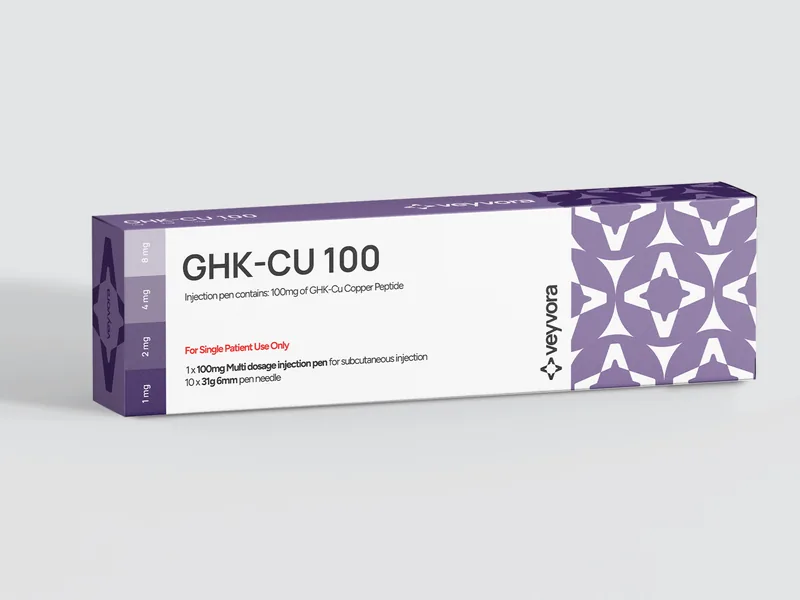
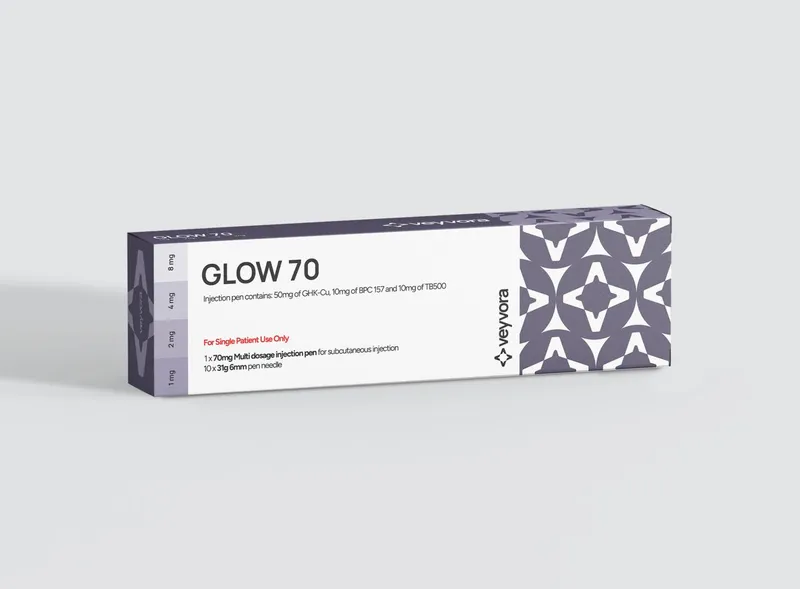
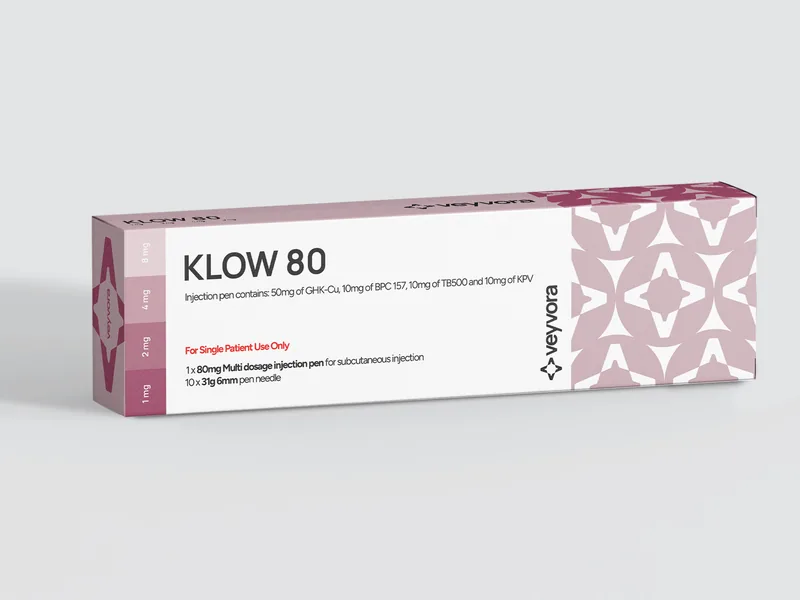
Overview
What this page covers: how GHK-Cu, GLOW and KLOW differ as research materials; what analytical documentation each format requires before use in a protocol; and how experimental complexity changes depending on whether you work with an isolated compound or a multi-peptide blend. All materials and discussion on this page are for laboratory and in-vitro research use only.
GHK-Cu is the isolated copper(II) complex of the tripeptide glycyl-L-histidyl-L-lysine, a single, structurally defined research material whose identity, purity and concentration can each be confirmed against one analyte. GLOW and KLOW are multi-peptide blends built around a copper-peptide research theme. The choice between them is a choice between experimental complexity levels, not potency levels: isolated GHK-Cu keeps the copper tripeptide as the sole variable, whereas a blend is a defined mixture only when every component is named, identified and assayed at batch level. Until that resolution is in hand, a blend leaves more variables to pin down in an in-vitro protocol; a blend CoA that confirms each component’s identity and proportion resolves them, which is why matching any of the three materials against its CoA before use is standard pre-protocol practice.
Regulatory classification for all three materials depends on presentation and intended claims and must be confirmed with the MHRA (Medicines and Healthcare products Regulatory Agency) for UK supply [2]. No human-use, administration or outcome claim attaches to any of these materials.
Direct Comparison
Isolated GHK-Cu keeps the copper tripeptide as the sole independent variable. A blend qualifies as a defined mixture only when every component is named, identified and assayed at batch level; without that resolution, a blend adds uncharacterised degrees of freedom to any in-vitro protocol.
GLOW and KLOW component lists, amounts and concentrations are given on the GLOW and KLOW product pages and confirmed on each batch’s certificate of analysis (CoA); consult those for the definitive composition. What an HPLC (high-performance liquid chromatography) purity figure can and cannot establish for any of these materials is covered at how to read HPLC purity results.
Identity and Mechanism Side by Side
The table below maps GHK-Cu, GLOW and KLOW against the criteria that matter most for material selection in copper peptide research: structural identity, the mechanism through which copper peptide activity is attributed in the literature, and the analytical burden each format places on batch verification. Values marked see product page + CoA are defined on Veyvora’s current product specification and confirmed on the matching CoA.
| Criterion | GHK-Cu | GLOW | KLOW |
|---|---|---|---|
| Chemical identity | Glycyl-L-histidyl-L-lysine copper(II) complex; single defined analyte | Multi-peptide blend; component list on the product page + CoA | Multi-peptide blend; component list on the product page + CoA |
| Molecular mass confirmation | Confirmable by mass spectrometry against one expected mass [1] | Requires component-resolved MS for each declared peptide [1] | Requires component-resolved MS for each declared peptide [1] |
| Attributed mechanism | Copper(II) coordination via the histidine imidazole and terminal amine; implicated in in-vitro modulation of matrix-related pathways in cell-culture models | Blend-dependent; mechanism attributable only after each component is identified and its proportion confirmed | Blend-dependent; mechanism attributable only after each component is identified and its proportion confirmed |
| HPLC purity scope | Single-analyte method can be validated for GHK-Cu specifically under ICH Q2(R2) principles [1] | A composite area-percent does not confirm presence or proportion of each component [1] | A composite area-percent does not confirm presence or proportion of each component [1] |
| Cold-chain format | See current label and IFU | See current label and IFU | See current label and IFU |
ICH Q2(R2), the International Council for Harmonisation’s guideline on analytical procedure validation, finalised 30 November 2023, establishes that a validated analytical procedure must demonstrate fitness for purpose, including specificity, accuracy, precision and robustness, for the analyte in question [1]. For GHK-Cu, that validation targets one substance; because only one analyte is in scope, the method can be fully characterised against a single reference standard. For GLOW or KLOW, the same rigour must be applied per component, because a single composite figure cannot distinguish between a correctly proportioned blend and one in which a constituent is absent or mis-stated. The GLOW 70 mg Skin & Repair Pen product page is the authoritative source for GLOW’s current component specification and should be consulted directly before any protocol is finalised.
Evidence Strength and Limitations
The body of published in-vitro research on GHK-Cu is more tractable than the evidence base for named commercial blends, because isolated GHK-Cu is a single defined analyte whose experimental variable can be controlled and whose findings can be replicated across independent laboratories. Blend-specific evidence is harder to evaluate: unless every component is identified and its proportion confirmed at batch level, a positive or negative result cannot be attributed to any one constituent with confidence.
Cell-culture studies implicating GHK-Cu in matrix-related pathways are preclinical and model-specific. Their conditions (concentration, cell type, exposure duration and passage number) must be matched to the proposed protocol before any finding is treated as transferable. Researchers should consult the primary literature directly and note the year of publication, because data published before 2023 may not reflect current understanding of copper-peptide behaviour in specific model systems.
For GLOW and KLOW, a blend-level mechanistic claim depends on the confirmed composition for the specific batch. The component list and proportions are given on the product page and confirmed on each batch CoA, so any mechanistic interpretation should be tied to that resolved composition rather than to the blend name alone.
A high HPLC area-percent does not prove that every declared blend component is present at the stated proportion. Co-elution, absent reference standards and methods optimised for a single peptide can all conceal missing or incorrectly proportioned constituents [1]. Component-specific, validated assays are therefore required before composition is treated as confirmed.
Study-Design Implications
The choice between isolated GHK-Cu and a multi-peptide blend such as GLOW or KLOW is, first, a question of experimental control: the fewer uncharacterised variables a model contains, the more confidently a result can be attributed to a specific agent. Isolated GHK-Cu keeps the copper tripeptide as the sole independent variable, which simplifies both the assay design and the interpretation of any observed effect. A blend introduces additional analytes — for example, any co-formulated peptides declared on the GLOW or KLOW specification — whose individual contributions cannot be separated unless the protocol includes component-resolved controls.
For cell-based models, the relevant parameters (concentration, exposure duration, cell type, passage number and matrix composition) must be matched to the published protocol being replicated or adapted, because findings from one cell type do not predict behaviour in another without independent verification.
Researchers working with blends should note that a composite purity figure does not confirm the proportion of each component present. Before any blend is used as a defined treatment, the batch documentation must resolve every declared constituent individually. ICH Q2(R2) (finalised 30 November 2023) requires that analytical procedures be shown fit for purpose, including specificity, accuracy and precision, before their outputs are treated as definitive composition data [1]; a method validated for a single peptide may not resolve all components in a blend. Retrieve the CoA for your chosen lot number and confirm that component-resolved identity and purity data are present before committing material to a protocol.
Material and Documentation Checks
Before committing any copper peptide material to a protocol, match the vial’s batch number to a CoA issued by a named laboratory.
For GHK-Cu, the CoA should report:
- Identity confirmed by an orthogonal method, specifically mass spectrometry consistent with the expected molecular mass
- HPLC purity validated for that single analyte under ICH Q2(R2) principles, which require specificity, accuracy and precision to be demonstrated before results are treated as definitive [1]
- Endotoxin assay result from a named testing laboratory
- Storage conditions as stated on the current label and instructions for use (IFU)
For GLOW or KLOW, a single composite HPLC area-percent does not confirm blend composition. The CoA must:
- Name every declared component individually
- Report each component’s identity and proportion separately, stating the method used
- Include endotoxin data
- Confirm storage requirements specific to that format and lot
A CoA that omits component-resolved data leaves the actual formulation uncharacterised for experimental purposes. Veyvora states that each batch is tested by an independent laboratory (Asterion Analytics) and then again by Veyvora’s own internal testing, using HPLC, mass spectrometry and endotoxin assay, against an assay-purity specification of ≥ 98.0% (Veyvora testing specification, 2026); researchers should verify this against the specific CoA for their lot rather than treating the general specification as batch-level confirmation.
Storage conditions must be read from the current label and IFU for each format, as lyophilised vials and solutions carry different requirements. Do not infer handling from other brands or earlier product inserts; consult the storage and stability guidance for current instructions. Researchers evaluating the GLOW blend should cross-reference the GLOW 70 mg Skin & Repair Pen product page for its first-party specification at the time of purchase.
Key Takeaways
- GHK-Cu is a single defined analyte; GLOW and KLOW are multi-peptide blends whose composition must be confirmed at batch level before use in any protocol.
- A composite HPLC area-percent does not confirm the presence or proportion of each component in a blend; component-resolved, validated assays are required.
- ICH Q2(R2) (finalised 30 November 2023) requires specificity, accuracy and precision to be demonstrated for each analyte in scope, not for the blend as a whole [1].
- Cell-culture findings for GHK-Cu are preclinical and model-specific; conditions must be matched to the proposed protocol before any result is treated as transferable.
- Regulatory classification for all three materials must be confirmed with the MHRA for UK supply [2].
Related Individual Research Pages
Once the GHK-Cu versus GLOW versus KLOW decision is made, read the specification for the chosen material before placing an order. Researchers whose protocol requires a defined multi-peptide skin-focused formulation should consult the Skin Stack pen stack page, which covers that catalogue category without duplicating the single-versus-blend comparison addressed here.
For current product listings, batch documentation access and purchase routing across all three materials, the Veyvora research peptides catalogue is the primary reference point.
Concrete next step: retrieve the CoA for your chosen lot number directly from Veyvora’s documentation portal, confirm that component-resolved identity and purity data are present for your material type, and cross-reference storage requirements against your facility’s cold-chain records before committing to a study design.
Sources
[1] database.ich.org, https://database.ich.org/sites/default/files/ICH_Q2%28R2%29_Guideline_2023_1130.pdf [2] Medicines and Healthcare products Regulatory Agency - GOV.UK, gov.uk, https://www.gov.uk/guidance/borderline-products-how-to-tell-if-your-product-is-a-medicine