

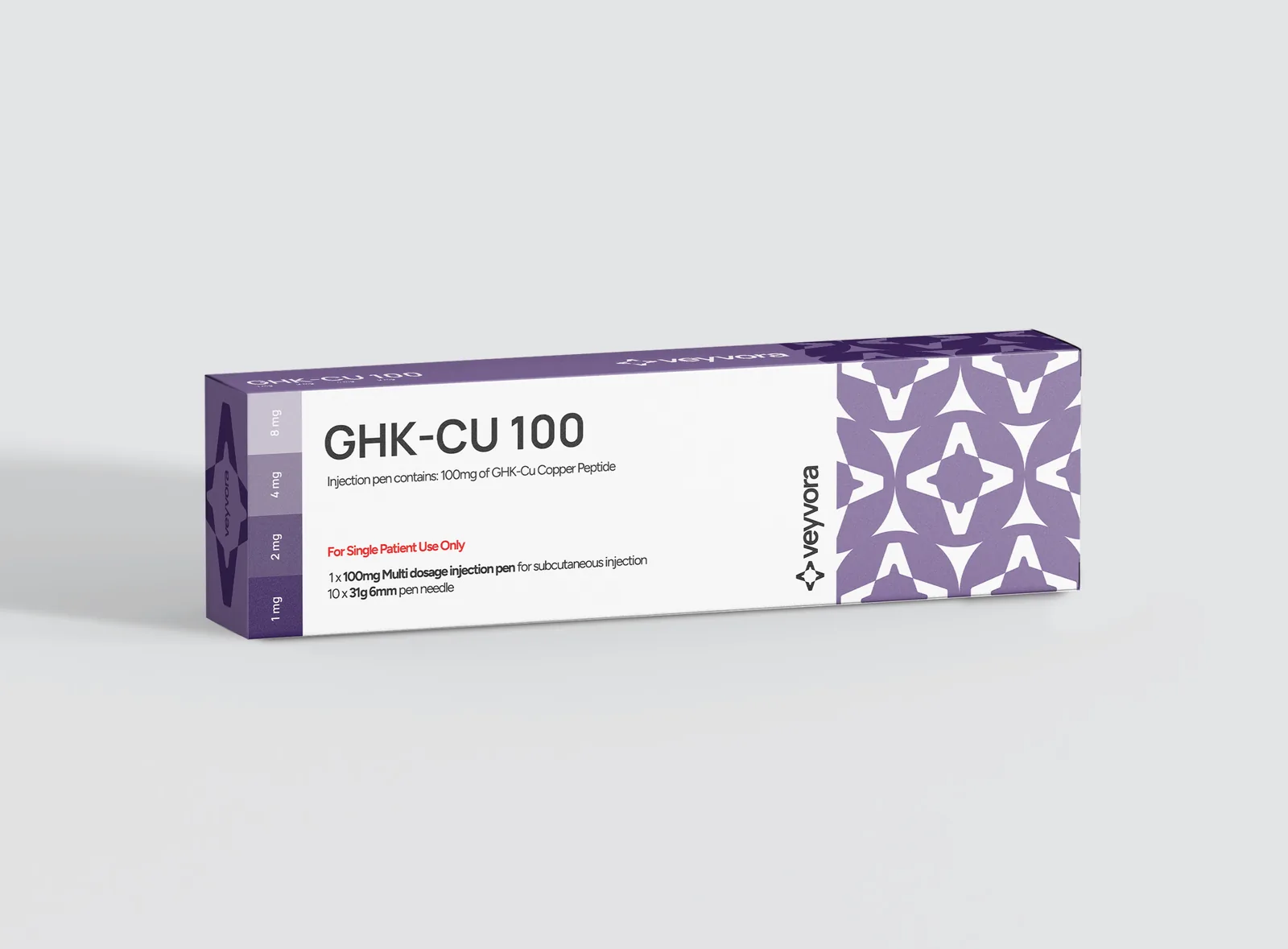
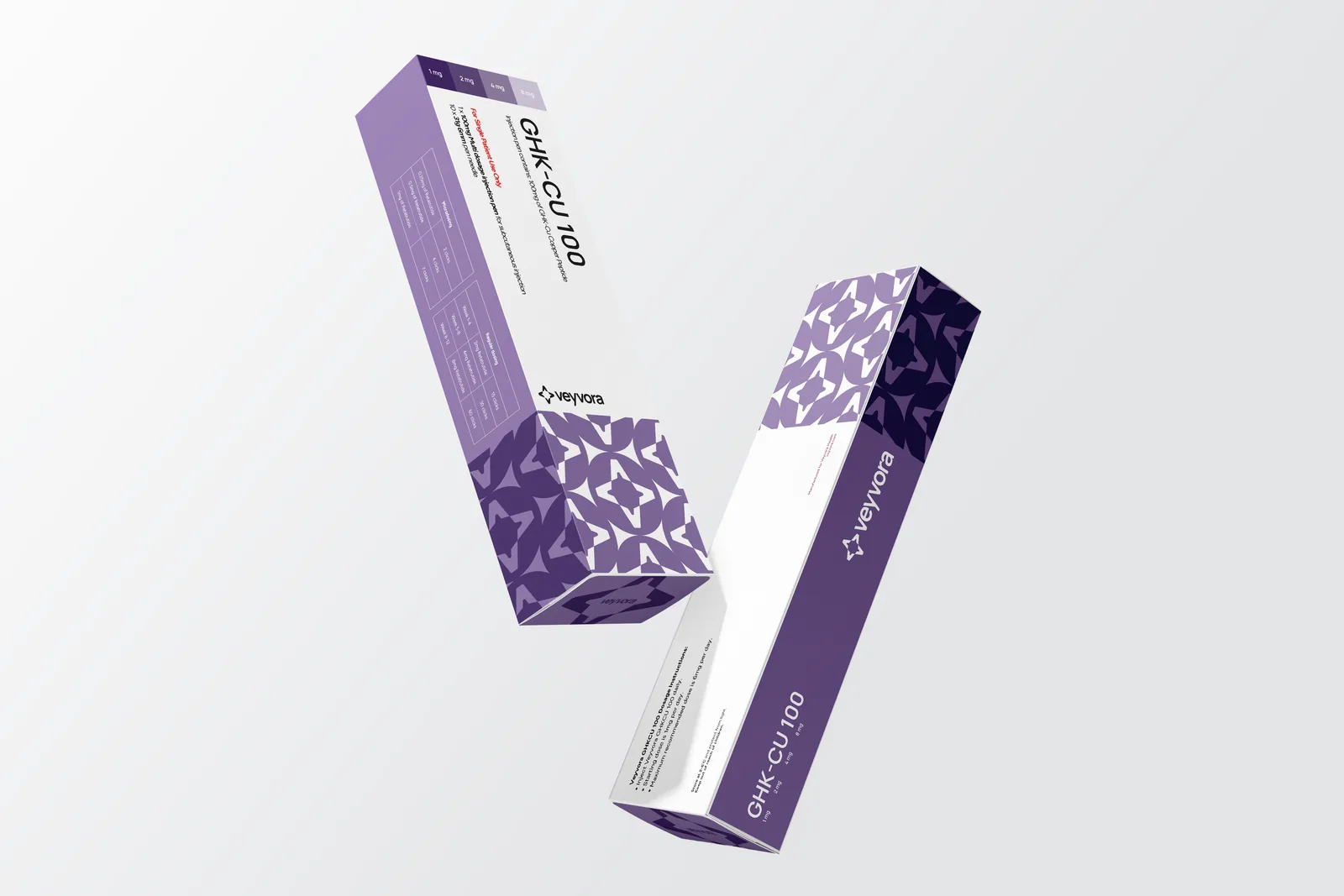
GHK-Cu 100
The copper tripeptide GHK-Cu, 100 mg per pen, studied in skin, collagen and repair research. Each click delivers 333 µg from a 3 mL · 300-click pen.
Featured in these stacks: Skin Stack.


how many clicks
for your dose?
This GHK-Cu 100 pen holds 100 mg across 300 clicks, so each click delivers 333 µg. Tap a dose or turn the dial; we'll count the clicks. For research reference only.
why researchers chose this pen
chose it for the click dosing, no syringes, no unit maths.
verified purity, checked against the public CoA before first use.
precise clicks in every 3 mL pen, the whole protocol in one barrel.
re-order or refer a colleague within three months.
about the
GHK-Cu 100 pen
GHK-Cu is a copper-binding tripeptide, supplied in a 3 mL / 300-click pen for skin, collagen and cellular research.
Certificate of analysiswhy a pen beats
a vial & syringe
Traditional research peptides arrive as lyophilised powder that must be reconstituted, drawn into insulin syringes, and converted from milligrams to units by hand, every step a chance for a dosing error.
A multi-dose pen removes the whole failure chain. The peptide arrives already dissolved and calibrated. Attach a fresh needle, turn the dial until you count your clicks, and you're done, the same audible-click mechanism trusted in insulin and GLP-1 pens worldwide.
Pens travel and store better, too: no open vials, no bent needles, no septum contamination after repeated draws. One sealed barrel, ten sterile needles, one dosing card.
how to buy
peptides safely
The peptide market has a purity problem: independent surveys routinely find underdosed, mislabelled or contaminated product sold online. The only reliable defence is third-party verification you can check yourself, not a supplier's own claims.
Before buying any peptide pen, ask three questions. Is every batch tested by an independent lab? Is the certificate of analysis available, so you can check your exact lot before first use? And does it ship cold-chain, insulated and gel-packed, so what was tested is what arrives?
Veyvora answers yes on every order, independent assay, a CoA on request against the batch number, and cold dispatch within 24 hours, paperwork packed inside.
pairs well with
view all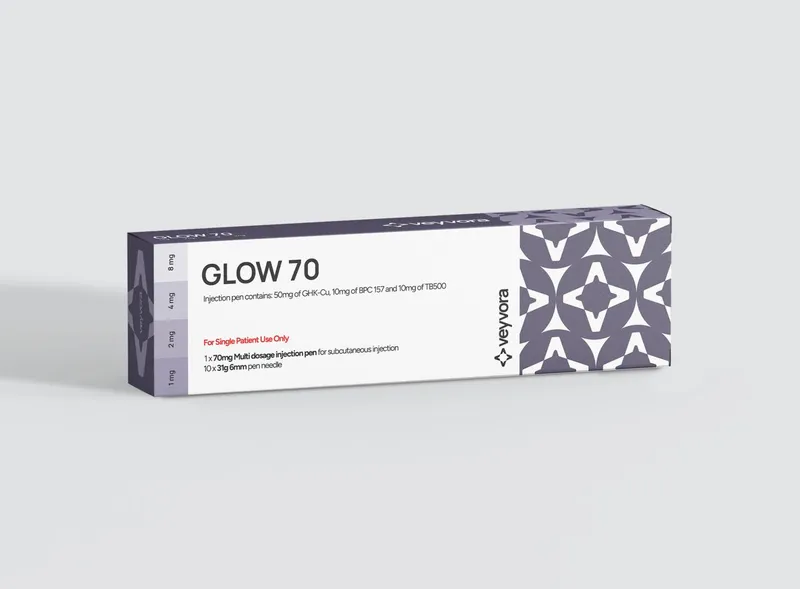
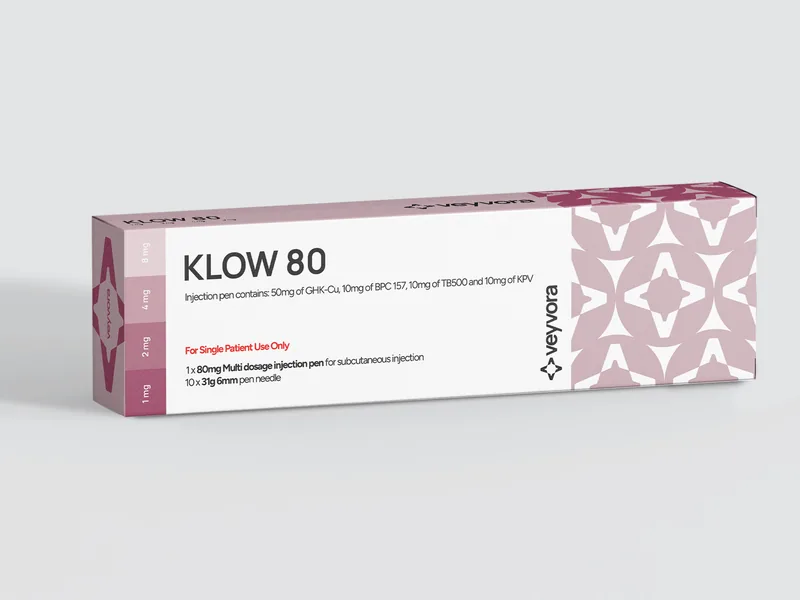
Overview
This page covers what the Veyvora GHK-Cu 100 mg Copper Peptide Research Pen is, what batch documentation ships with it, and how to check current pricing and availability in GBP on the Veyvora product page.
A GHK-Cu dosing pen is a multi-dose research device pre-filled with glycyl-L-histidyl-L-lysine copper(II) complex, PubChem CID 71587328, molecular formula C₁₄H₂₂CuN₆O₄, supplied strictly for in-vitro laboratory research use only and not presented as a prescription, pharmacy or consumer product [1].
GHK-Cu holds no MHRA marketing authorisation and does not appear as an EMA-authorised active substance as of 2026 [2]. Purchase is appropriate only for registered research facilities conducting controlled in-vitro work.
Visit the Veyvora product page to confirm current GBP pricing, stock status and minimum order quantity before placing an order.
Quick-Reference Specification
| Parameter | Labelled value | Status |
|---|---|---|
| Peptide | GHK-Cu (glycyl-L-histidyl-L-lysine copper(II)) | Verified chemical identity [1] |
| Total fill | 100 mg per pen | Confirmed on the batch CoA |
| Volume | 3 mL | Pre-filled solution |
| Click count | 300 clicks | Fixed pen format |
| Quantity per click | ~333.3 µg | Arithmetic from labelled figures; not a dosing schedule |
| Intended use | In-vitro laboratory research only | Confirmed scope |
Availability and Purchase Path
For the current price in GBP, stock status, VAT-inclusive totals and minimum order quantity, see the Veyvora United Kingdom (en-GB) product page. Distributor enquiries regarding bulk or 50-unit SKU pricing can be directed to Veyvora’s trade account team.
Product Identity and Scope
The GHK-Cu 100 mg Copper Peptide Research Pen is a multi-dose laboratory device pre-filled with glycyl-L-histidyl-L-lysine copper(II) complex, PubChem CID 71587328, molecular formula C₁₄H₂₂CuN₆O₄, presented in a 3 mL, 300-click pen format with a labelled total fill of 100 mg, supplied strictly for in-vitro research use only and not as a prescription, pharmacy or consumer product [1].
GHK-Cu carries no MHRA authorisation and does not appear as an EMA-authorised active substance as of 2026 [2], so any pen labelled for laboratory use is a research chemical rather than a licensed medicinal product. The labelled milligram quantity must not be interpreted as a clinical dosing schedule or as evidence of human skin outcomes.
The 100 mg total fill, 3 mL volume and 300-click count define the pen’s standard format. Every pen ships with an independent, batch-specific certificate of analysis (CoA) from Asterion Analytics, so the compound’s identity and HPLC purity are recorded for the exact lot; researchers should follow the process for matching a CoA to your pen to confirm that the batch number on the physical device corresponds to the analytical record.
Verified Specifications
GHK-Cu (glycyl-L-histidyl-L-lysine copper(II) complex, PubChem CID 71587328, molecular formula C₁₄H₂₂CuN₆O₄) is the active substance in the Veyvora research pen. The specification fields below describe the pen’s standard format; the identity and HPLC purity of each batch are confirmed on the independent, batch-specific CoA that ships with every pen.
Specification Table
| Parameter | Value | Verification status |
|---|---|---|
| Active substance | GHK-Cu (PubChem CID 71587328) | Confirmed, authoritative chemical record |
| Molecular formula | C₁₄H₂₂CuN₆O₄ | Confirmed, authoritative chemical record |
| Total labelled fill | 100 mg | Confirmed on the batch CoA |
| Fill volume | 3 mL | Pre-filled solution |
| Click count | 300 clicks | Fixed pen format |
| Calculated quantity per click | ~333.3 µg (100 mg ÷ 300) | Arithmetic only; not a measured assay result |
| Solvent / excipients | Aqueous solution | Per current SDS |
| Sterility / endotoxin | Reported on the batch CoA | Per-lot analytical record |
| Appearance | Solution (pre-filled pen) | Per current label |
The per-click arithmetic (approximately 333.3 µg) is a labelled-quantity calculation, not a measured batch result, and must not be used as a dosing reference for any human or animal application. Each pen ships with its batch-specific CoA; researchers can also request the safety data sheet (SDS) from Veyvora and should consult the storage and handling guidance before working with the pen in a laboratory setting.
Batch Documentation and Analytical Evidence
Every Veyvora GHK-Cu 100 mg pen ships with an independent, batch-specific certificate of analysis (CoA) from Asterion Analytics, reporting the compound’s identity by LC-MS, its HPLC (high-performance liquid chromatography) purity against a ≥ 98.0% specification, and a safety panel that includes an endotoxin result. Veyvora then verifies each batch again with its own internal testing before release. The CoA is tied to the lot number printed on the pen, so it describes your exact material; match your batch to it before any laboratory work begins.
What the Certificate Covers
A CoA carries analytical weight because it is specific to the lot number printed on the pen itself. The Veyvora CoA references that exact batch, names the testing laboratory (Asterion Analytics), states the analytical method (HPLC for identity and purity, mass spectrometry for molecular confirmation, and a limulus amebocyte lysate (LAL) or equivalent assay for endotoxin), and records the laboratory’s accreditation status. In Great Britain, UKAS (United Kingdom Accreditation Service) accreditation is the relevant benchmark.
Because the Veyvora CoA is issued from an independent laboratory assay and is matched to the batch number, researchers can verify it against the lot printed on the pen. GHK-Cu (PubChem CID 71587328) does not appear as a European Pharmacopoeia monograph substance in the publicly searchable EDQM (European Directorate for the Quality of Medicines) database as of this 2026 pass, which means no Ph. Eur. identity or purity specification exists to serve as an external reference standard; the batch CoA is therefore the primary analytical record. Researchers should record the testing laboratory’s name, accreditation number, and method detection limits alongside any CoA retained for audit purposes.
For guidance on interpreting what analytical testing does and does not establish, see what HPLC purity does and does not prove. Researchers who find that the GHK-Cu pen format does not suit their protocol can browse research peptides by focus to identify an alternative catalogue presentation.
Handling and Storage
The GHK-Cu 100 mg Copper Peptide Research Pen is a pre-filled solution and is dispatched cold-chain. For the recommended storage temperature, reconstituted-stability window and in-pen hold time, consult Veyvora’s current label, SDS and storage and handling guidance before any laboratory work begins.
What to Confirm Before Use
Researchers should confirm the following against Veyvora’s current documentation before use:
- Recommended storage temperature range and whether the pen requires refrigeration or freezing prior to first use
- In-pen stability window once the pen has been activated or punctured
- Light-sensitivity requirements and recommended container type for secondary storage
- Solvent identity for the pre-filled solution and any secondary-storage instructions
- SDS reference number and COSHH (Control of Substances Hazardous to Health) classification applicable to the batch
Institutional COSHH assessments should be completed against the current SDS before the pen is used in any protocol. Peptide chemistry literature describes GHK-Cu (PubChem CID 71587328) as a copper-complexed tripeptide, but the stability of the 100 mg pen formulation depends on excipients, fill volume, and container closure, none of which can be inferred from chemical identity alone.
Ordering Information
Current GBP pricing, stock level, minimum order quantity, VAT treatment and UK shipping cost for the Veyvora GHK-Cu 100 mg Copper Peptide Research Pen are shown on the Veyvora United Kingdom (en-GB) product page. Prices on aggregator sites, forums or third-party listings are not authoritative; use the Veyvora product page for procurement decisions.
Prospective buyers and distributors can confirm current pricing, stock availability, lead times and minimum order requirements on the product page or via Veyvora’s trade account team before raising a purchase order. Payment methods, VAT applicability and courier terms are shown at Veyvora’s checkout or in the distributor agreement.
Researchers building a broader in-vitro programme can review the Skin Stack research collection for context on related research-grade compounds. Neither link constitutes a purchasing recommendation or a clinical endorsement.
To confirm current batch availability, GBP pricing and CoA documentation, visit the live Veyvora product page and match the lot number on your pen to the corresponding certificate before beginning any assay.
Research-Use-Only Limitations
In Great Britain, a product presented for treating or preventing disease in humans is a medicinal product and generally requires a marketing authorisation from the MHRA (Medicines and Healthcare products Regulatory Agency); GHK-Cu holds no such authorisation, and a “research use only” label does not create a lawful human-use pathway [2]. The GHK-Cu 100 mg pen is supplied for in-vitro laboratory research only and is not for human or veterinary use.
Researchers handling the GHK-Cu 100 mg Copper Peptide Research Pen should treat labelled click counts as a format descriptor for in-vitro dispensing, not as a dosing schedule. Institutions procuring the pen for controlled laboratory work should confirm batch identity against supplier documentation by matching a CoA to your pen before use.
Related Research and Comparison Pages
GHK-Cu is the copper(II) complex of the tripeptide glycyl-L-histidyl-L-lysine (PubChem CID 71587328). Published in-vitro literature, summarised in the GHK-Cu research profile, addresses its coordination chemistry and extracellular-matrix signalling properties, not the fill accuracy or click format of any merchant’s pen. Researchers drawing on that literature should keep the distinction clear: primary papers support mechanistic hypotheses for controlled laboratory work, not product validation.
Before using the GHK-Cu 100 mg Copper Peptide Research Pen in any protocol, consult the storage and handling guidance for the cold-chain prerequisites that underpin responsible laboratory use.
Key Takeaways
- The Veyvora GHK-Cu 100 mg pen is a research chemical (PubChem CID 71587328) with no MHRA or EMA marketing authorisation; it is lawful only for controlled in-vitro laboratory use.
- The pen’s format, 100 mg fill, 3 mL solution, 300 clicks, ~333.3 µg per click, is fixed; each batch’s identity and HPLC purity (≥ 98.0%) are confirmed on the independent, batch-specific CoA that ships with every pen.
- Match the lot-specific CoA that ships with the pen to your batch, and request the SDS and COSHH classification from Veyvora before use; UKAS-accredited laboratory results are the appropriate benchmark in Great Britain.
- Current GBP pricing, stock status and VAT treatment are shown on the Veyvora United Kingdom (en-GB) product page.
Sources
[1] GHK-Cu (glycyl-L-histidyl-L-lysine copper complex), PubChem CID 71587328, National Library of Medicine, https://pubchem.ncbi.nlm.nih.gov/compound/71587328 [2] Borderline products: how to tell if your product is a medicine, Medicines and Healthcare products Regulatory Agency (MHRA), GOV.UK, https://www.gov.uk/guidance/borderline-products-how-to-tell-if-your-product-is-a-medicine