
MOTS-c vs SS-31
Both are mitochondrial peptides, and both sit in the same research pen — but they approach the mitochondrion from opposite directions. One comes from it, the other targets it. That's the whole distinction.
derived vs targeting
MOTS-c is a mitochondrial-derived peptide — encoded within mitochondrial DNA and studied as a signalling molecule in metabolic research. SS-31 (elamipretide) is a mitochondria-targeting peptide, studied for its association with the inner mitochondrial membrane. MOTS-c comes from the mitochondrion; SS-31 concentrates at it.
signalling vs structure
The research angles differ accordingly. MOTS-c is examined on the signalling side — how a mitochondrial-derived peptide influences metabolism. SS-31 is examined on the structural side — its association with the membrane itself. Two different questions about the same organelle.
why they share a pen
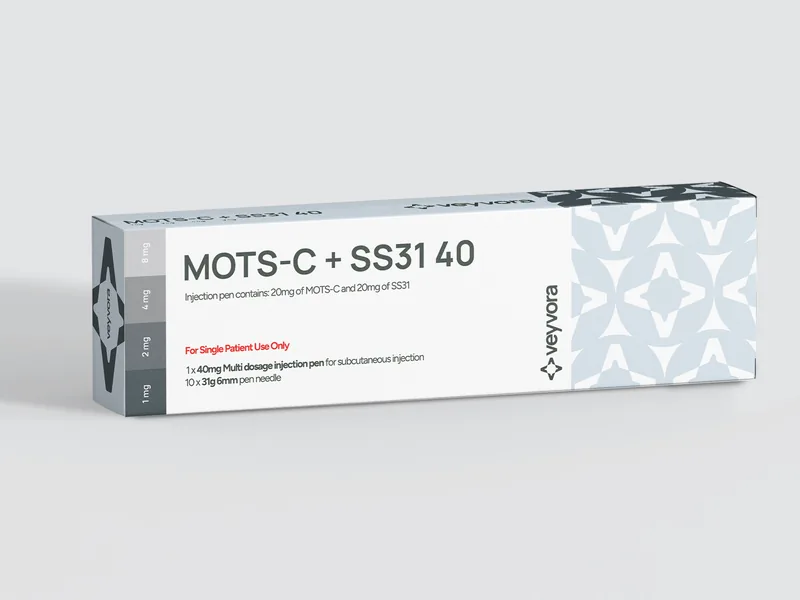
Because they cover the signalling and structural sides between them, combining the two lets a single research model look at both — the reasoning behind the MOTS-c + SS-31 pen. Read the compound detail in the research explainer, and see how they relate to NAD+ in the same category.
verifying the blend
As a two-compound pen, the certificate of analysis should confirm each component's identity and proportion — see how to read a CoA. More in the longevity & cellular range.
research use only
Both compounds are supplied strictly for in-vitro and laboratory research use only — not medicines, not for human or veterinary consumption. Nothing here is dosing, medical or treatment guidance.
the research pens
Pre-filled, batch-numbered and independently assayed. Save one to your list and we'll email you the moment it's available in your country.
Overview
MOTS-c and the SS-31 peptide (elamipretide) are both studied for their relationships with mitochondrial function, but they represent distinct classes of research material: MOTS-c is an endogenous 16-amino-acid peptide encoded within mitochondrial DNA that acts as a signalling molecule, whereas SS-31 is a synthetic mitochondria-targeting peptide designed to associate with the inner mitochondrial membrane via cardiolipin binding. Treating them as interchangeable would misrepresent their mechanisms and confound experimental attribution.
The table below sets out the primary distinguishing characteristics relevant to laboratory researchers selecting between or combining these materials. All materials discussed on this page are for laboratory and in-vitro research use only.
| Criterion | MOTS-c | SS-31 (elamipretide) |
|---|---|---|
| Class | Mitochondria-derived signalling peptide | Synthetic mitochondria-targeting peptide |
| Origin | Encoded in mitochondrial 12S rRNA region [1] | Synthetic; not endogenously encoded |
| Primary target | Folate cycle / AMPK pathway [1] | Cardiolipin at inner mitochondrial membrane [2] |
| Research question fit | Metabolic signalling, insulin sensitivity, stress response | Membrane bioenergetics, ADP/ATP transport, ANT function |
| Regulatory note | No authorisation identified in retrieved sources | EU orphan designation granted 16 May 2022 for myopathic mitochondrial DNA depletion syndrome; designation ≠ marketing authorisation [2] |
| Evidence base (preclinical) | 2015 Cell Metabolism mechanistic study [1] | 2023 Geroscience mechanistic study; EMA orphan-designation dossier (2022) [2] |
| Research use only | Yes | Yes |
Direct Comparison
MOTS-c and SS-31 are distinct classes of mitochondrial research peptide: MOTS-c is an endogenous 16-amino-acid peptide encoded within mitochondrial DNA that functions as a signalling molecule, whereas SS-31 (elamipretide) is a synthetic peptide designed to target the inner mitochondrial membrane through cardiolipin binding [1][2]. Treating them as interchangeable would misrepresent their mechanisms and confound experimental attribution.
MOTS-c is a mitochondria-derived peptide studied primarily as a signalling molecule affecting metabolic homeostasis [1]. SS-31, also known as elamipretide, is a mitochondria-targeting peptide associated with the inner mitochondrial membrane; the European Medicines Agency granted SS-31 EU orphan designation on 16 May 2022 for myopathic mitochondrial DNA depletion syndrome, though orphan designation does not constitute a marketing authorisation [2]. A licensed elamipretide product (FDA accelerated approval as Forzinity, 19 September 2025, for Barth syndrome) exists in the US, but that approval applies to the finished drug product only and does not transfer to unlicensed SS-31 research material.
The practical framing for laboratory researchers is therefore “mitochondrial signalling peptide” versus “mitochondria-targeting peptide”. For a deeper account of each compound’s structure and proposed mechanism, the MOTS-c + SS-31 research explainer sets out the biological context in full. All materials discussed here are for laboratory and in-vitro research use only.
Identity and Mechanism Side by Side
MOTS-c and SS-31 differ in origin, structure and proposed mechanism: MOTS-c is an endogenous 16-amino-acid peptide encoded within the mitochondrial 12S rRNA region that regulates metabolic homeostasis via inhibition of the folate cycle, reduced de novo purine biosynthesis and AMPK activation [1], whereas SS-31 (elamipretide) is a synthetic tetrapeptide designed to bind cardiolipin at the inner mitochondrial membrane and, in a 2023 preclinical study, improved ADP sensitivity in aged mitochondria by increasing ADP uptake through the adenine nucleotide translocator [1]. The EMA’s orphan-designation record for elamipretide (EU/3/22/2614, 16 May 2022) describes it as a mitochondria-protective agent expected to support ATP production and mitochondrial structure through cardiolipin binding, though that designation is not a marketing authorisation [2].
| Criterion | MOTS-c | SS-31 (elamipretide) |
|---|---|---|
| Origin | Endogenous; encoded in mitochondrial DNA | Synthetic; not encoded in the genome |
| Length | 16 amino acids [1] | 4 amino acids [2] |
| Primary target | Folate cycle / AMPK pathway [1] | Cardiolipin at inner mitochondrial membrane [2] |
| Proposed role in research | Metabolic signalling and stress response [1] | Bioenergetics and ADP/ATP transport [1] |
| Regulatory status (EU, 2022) | No orphan designation identified in primary sources | EU orphan designation granted 16 May 2022 [2] |
| Research context | In-vitro and preclinical metabolic models | In-vitro and preclinical membrane/bioenergetic models |
Because HPLC purity confirms compound concentration but cannot alone confirm sequence identity, researchers should consult what HPLC purity does and does not prove before treating a purity certificate as complete identity verification. Both materials are for laboratory and in-vitro research use only.
Evidence Strength and Limitations
The published evidence for both MOTS-c and SS-31 is mechanistic and preclinical; neither body of literature validates a specific commercial batch or supports human-outcome claims, and researchers should treat the two evidence bases as distinct in maturity and model type.
MOTS-c: Mechanistic and Mouse-Model Evidence
The foundational MOTS-c publication is a 2015 Cell Metabolism study demonstrating that a mitochondrial-encoded peptide regulates metabolic pathways and alters phenotypes in mouse models [1]. That work establishes biological plausibility for MOTS-c as a signalling molecule but does not constitute translational validation. No equivalent regulatory-body assessment of MOTS-c was identified in the primary sources retrieved, so any claim beyond a preclinical research context remains unverified.
SS-31: Preclinical Mechanistic Evidence Plus Regulatory Acknowledgement
For SS-31 (elamipretide), a 2023 Geroscience paper provides mechanistic evidence in aged mitochondria and muscle and heart models, showing improved ADP sensitivity through the adenine nucleotide translocator [1]. Separately, the EMA’s orphan-designation record (EU/3/22/2614, 16 May 2022) states that experimental models and ongoing clinical trials supported the designation at that time [2]. The EMA record is not a marketing authorisation and does not confirm clinical efficacy or product safety [2].
Neither source class, primary mechanistic publications nor regulatory designation documents, proves the quality, sequence identity or purity of any supplier’s material. Researchers sourcing either peptide for in-vitro work should consult batch-specific certificates of analysis from the Longevity & Cellular Research Pens catalogue and cross-reference them against independent assay data before use. All materials are for laboratory and in-vitro research use only; no human-outcome inference is warranted from the preclinical literature cited here.
Study-Design Implications
MOTS-c and SS-31 address different mitochondrial targets, so combining them in a single experimental design is only justified when the research question explicitly spans both metabolic signalling and inner-membrane bioenergetics. Otherwise, attributing any observed effect to one compound rather than the other becomes methodologically difficult.
Matching Compound to Research Question
MOTS-c is best positioned for experiments examining insulin sensitivity, AMPK activation or folate-cycle regulation, where a mitochondrial-encoded signalling peptide is the appropriate tool [1]. SS-31 (elamipretide) is better suited to questions about cardiolipin binding, ADP/ATP transport or mitochondrial membrane integrity, as the 2023 Geroscience mechanistic data show improved ADP sensitivity through the adenine nucleotide translocator in aged mitochondria and muscle models [1]. Selecting the wrong compound for a given question can do more than reduce signal; it may introduce confounding that cannot be resolved at the analysis stage.
Specifying Materials in Study Write-Ups
Any protocol or publication should state the model system, the route of in-vitro exposure, and the exact material identity, sequence, batch number and confirmed purity, rather than referring to a compound class. The MOTS-c + SS-31 research explainer provides the deeper mechanistic context needed to justify compound selection before a protocol is finalised. Batch identity should be confirmed against the certificate of analysis before first use; the batch verification guide sets out that process. All materials are for laboratory and in-vitro research use only; no human-use inference should be drawn from the preclinical literature cited here [1][2].
Material and Documentation Checks
The most defensible starting point for any MOTS-c or SS-31 research protocol is the batch-specific certificate of analysis (CoA), checked against the batch number before first use. Every Veyvora research pen in the mitochondrial range is independently assayed and ships with a batch-specific CoA reporting identity and HPLC purity [3]. The CoA confirms the analytical result for that batch; independent validation of biological activity or safety remains a separate step.
What HPLC Purity Does and Does Not Confirm
An HPLC purity figure above a stated threshold confirms that the dominant peak in the chromatogram matches the expected retention time and relative area. On its own, it does not confirm sequence identity or the absence of low-abundance impurities that HPLC cannot resolve. Mass spectrometry data, where available on the CoA, provides the complementary identity check. Researchers should consult what HPLC purity does and does not prove before treating a single purity figure as complete identity verification.
Cold-Chain and Storage Verification
Veyvora states that research-peptide orders are dispatched under documented cold-chain conditions in an insulated bag with a gel ice pack [3]. On receipt, inspect the cold-chain packaging before the outer packaging is opened; if it appears compromised, query the supplier before the material enters any protocol. For full reconstitution and storage requirements, research-peptide storage and cold-chain handling provides the relevant guidance. Current price and availability are shown on the live product page.
All materials are for laboratory and in-vitro research use only; no human-use inference should be drawn from batch documentation or supplier statements [3].
Related Individual Research Pages
Veyvora supplies MOTS-c and SS-31 together as a combined research pen within the Longevity & Cellular Research Pens category, framed as a dual research tool rather than a claim of synergy [3][4].
Researchers who have worked through the mechanism and evidence comparison above and are ready to make a sourcing decision can review batch-specific certificate of analysis details directly through Veyvora’s research-peptide catalogue. Check the batch number against the published CoA before the material enters any protocol; current price and availability are shown on the live product page [3].
All materials are for laboratory and in-vitro research use only.
Sources
[1] MOTS-c and SS-31 (elamipretide) mechanistic studies (review), pmc.ncbi.nlm.nih.gov, https://pmc.ncbi.nlm.nih.gov/articles/PMC9570330/ [2] EU/3/22/2614 - orphan designation for treatment of myopathic mitochondrial DNA depletion syndrome | European Medicines Agency (EMA), ema.europa.eu, 2022, https://www.ema.europa.eu/en/medicines/human/orphan-designations/eu-3-22-2614 [3] Longevity & Cellular Research Pens | Veyvora, veyvora.com, https://veyvora.com/categories/longevity [4] Explore Research Peptides by Focus | Veyvora, veyvora.com, https://veyvora.com/