
Longevity & Cellular
Cellular-energy and mitochondrial pens studied in longevity research.
Overview
For cellular-energy and longevity research in 2026, the three most-compared in-vitro tools are the NAD+ research pen, the MOTS-c peptide pen and the SS-31 peptide pen. Each targets a distinct biological mechanism: NAD+ is a redox coenzyme studied in sirtuin and PARP signalling pathways, whereas MOTS-c and SS-31 are mitochondrially associated peptides examined for roles in AMPK activation and cardiolipin binding respectively [1]. All materials discussed on this page are supplied for laboratory and in-vitro research use only.
| Research tool | Biological category | Primary research mechanism | Format (Veyvora, 2026) | Price / Availability |
|---|---|---|---|---|
| NAD+ | Redox coenzyme | Sirtuin/PARP signalling; metabolic cofactor pool | 3 mL pen, 300 clicks at 133 µg per click | Confirm with Veyvora before ordering |
| MOTS-c | mtDNA-encoded peptide (16 amino acids) | AMPK/folate–AICAR pathway signalling | 3 mL pen format | Confirm with Veyvora before ordering |
| SS-31 (elamipretide) | Synthetic tetrapeptide | Cardiolipin binding on inner mitochondrial membrane | 3 mL pen format | Confirm with Veyvora before ordering |
Current price and availability for all three must be confirmed directly with Veyvora prior to any procurement decision; these figures are not reproduced here to avoid presenting stale commercial data.
What This Guide Covers
This guide compares three in-vitro research tools — the NAD+ research pen, the MOTS-c peptide pen and the SS-31 peptide pen — on the basis of biological mechanism, pen format, quality-verification evidence and cold-chain handling. No human-outcome claims are made or implied anywhere in this guide, and no human treatment, administration or dosing guidance is provided.
NAD+ is a pyridine dinucleotide coenzyme studied in redox, sirtuin and PARP signalling pathways. MOTS-c and SS-31 are mitochondrially associated peptides examined for distinct membrane and kinase-signalling roles. Current literature does not treat the three as interchangeable research tools [1].
Pricing and stock figures are omitted here because they change without notice; researchers should confirm current availability directly with Veyvora before any procurement decision. For the underlying coenzyme biology, NAD+ research explained provides deeper mechanism and evidence context.
Research Areas and Catalogue Entities
Veyvora’s longevity research catalogue for 2026 contains three distinct pen-format tools — the NAD+ research pen, the MOTS-c peptide pen and the SS-31 peptide pen. Each occupies a separate mechanistic category and is supplied exclusively for in-vitro laboratory research use.
NAD+ Research Pen
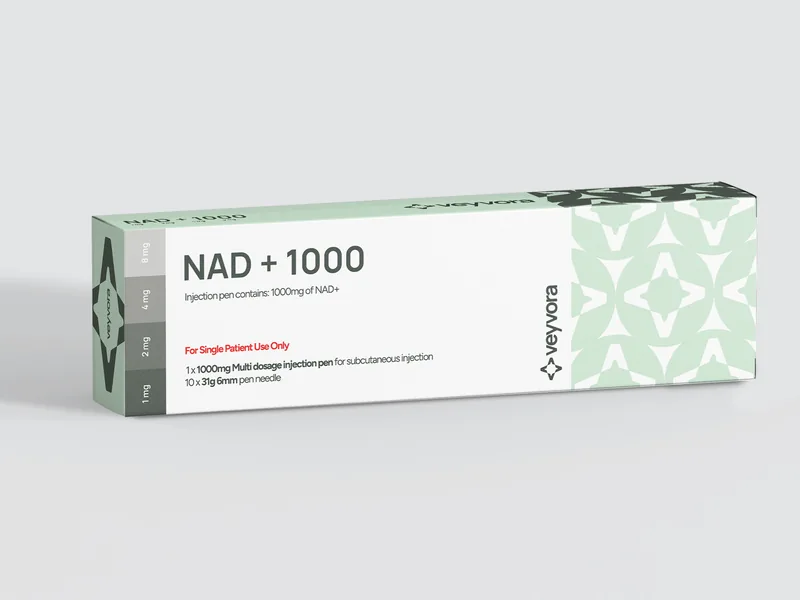
NAD+ (nicotinamide adenine dinucleotide) is a pyridine dinucleotide coenzyme studied in redox biology, sirtuin activation and PARP-mediated DNA-repair signalling. Research interest centres on coenzyme pool size and the enzymes that regulate it, NAMPT, NMNAT and CD38, rather than on peptide–membrane interactions. The NAD+ 1000 research pen is listed in the Veyvora 2026 catalogue as a 3 mL pen-format device delivering 300 clicks at 133 µg per click, supplied with a dosing card and 31G 6 mm pen needles. Operators must confirm current availability and price directly with Veyvora before any procurement decision, as these values are not reproduced here.
MOTS-c and SS-31 Peptide Pens
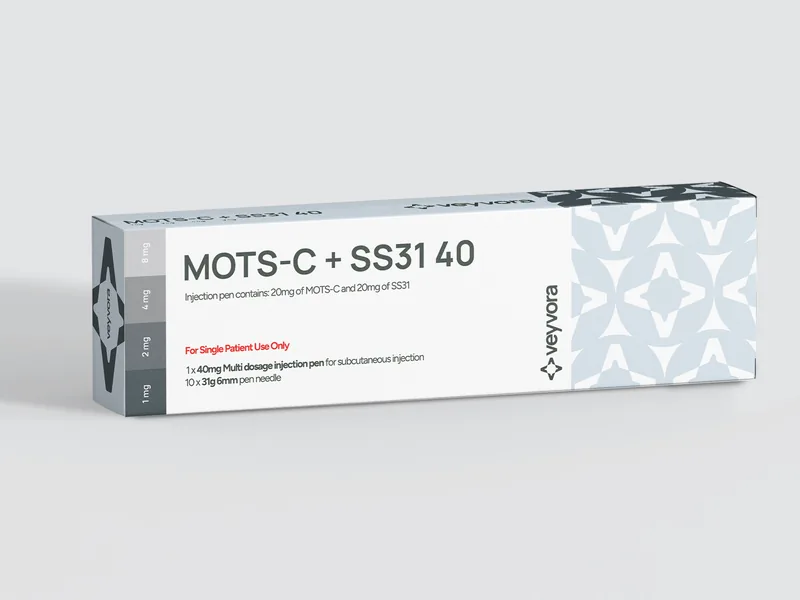
MOTS-c is a 16-amino-acid peptide encoded within mitochondrial DNA, studied for its activity on AMPK and folate–AICAR signalling pathways [1]. SS-31 (elamipretide) is a synthetic tetrapeptide examined for its capacity to associate with cardiolipin on the inner mitochondrial membrane [1]. Neither peptide shares a mechanistic category with NAD+ coenzyme biology, and current peer-reviewed literature does not treat the three entities as interchangeable research tools. For the combined research context of these two mitochondrial peptides, MOTS-c + SS-31 research explained provides the relevant background.
Veyvora states that each batch across all three pen formats is tested by two independent laboratories using HPLC, mass spectrometry and endotoxin assay, with a reported purity threshold above 98% (Veyvora quality documentation, 2026). Researchers interpreting batch certificates of analysis should consult how to read HPLC purity before drawing conclusions from the purity field.
Compare the Research Roles
NAD+, MOTS-c and SS-31 occupy distinct mechanistic categories in cellular-energy research. Selecting between them depends on the signalling pathway under investigation rather than any shared classification.
| Entity | Identity | Primary Research Question | Pen Format (Veyvora, 2026) | Documentation |
|---|---|---|---|---|
| NAD+ | Pyridine dinucleotide coenzyme | Redox balance, sirtuin and PARP signalling; coenzyme pool regulation via NAMPT, NMNAT and CD38 | 3 mL, 300 clicks, 133 µg per click; 31G 6 mm needles supplied | Batch CoA: HPLC, MS, endotoxin; purity threshold stated above 98% (Veyvora, 2026) |
| MOTS-c | 16-amino-acid mtDNA-encoded peptide | AMPK activation and folate–AICAR pathway signalling [1] | Confirm current format with Veyvora | Batch CoA: HPLC, MS, endotoxin; purity threshold stated above 98% (Veyvora, 2026) |
| SS-31 (elamipretide) | Synthetic tetrapeptide | Cardiolipin association on the inner mitochondrial membrane [1] | Confirm current format with Veyvora | Batch CoA: HPLC, MS, endotoxin; purity threshold stated above 98% (Veyvora, 2026) |
A researcher investigating redox or sirtuin pathways would select the NAD+ research pen; one examining mitochondrial membrane dynamics would select SS-31; one studying AMPK-mediated metabolic signalling would select MOTS-c. Peer-reviewed literature does not treat these three entities as interchangeable [1].
Before committing to any batch, verify your batch against its CoA to confirm that the identity, purity and endotoxin values align with your protocol requirements. For maintaining the documented 2–8 °C storage condition across all three formats, consult storage and stability guidance.
Format specifications and availability for MOTS-c and SS-31 pens must be confirmed directly with Veyvora prior to any procurement decision, and all three pen formats are supplied for in-vitro laboratory research only.
Evidence Boundaries
The three research tools covered in this guide operate at different levels of the evidence hierarchy. NAD+ coenzyme biology is supported by extensive mechanistic and preclinical literature addressing NAMPT, NMNAT and CD38 pathways, sirtuin activation and PARP signalling. MOTS-c and SS-31 research sits predominantly at the peptide-mechanism and early preclinical stage, with MOTS-c characterised through AMPK and folate–AICAR pathway studies and SS-31 through cardiolipin-binding assays on the inner mitochondrial membrane [1].
What the Evidence Does and Does Not Support
Mechanistic findings from cell-free or cell-based assays establish pathway interactions under controlled in-vitro conditions; they do not establish efficacy or safety in living systems. Preclinical rodent data, where it exists for any of these entities, cannot be extrapolated to human outcomes without independent clinical validation. No single peer-reviewed paper published between 2024 and 2026 treats NAD+, MOTS-c and SS-31 as interchangeable longevity tools or presents a head-to-head in-vitro methods comparison across all three [1]. Researchers should treat each entity as mechanistically distinct and select assay designs accordingly.
All materials available through the Veyvora research peptide catalogue are supplied for in-vitro laboratory research only.
Laboratory Procurement Checks
Before ordering any research-grade longevity tool, confirm that the supplier provides batch-specific documentation covering at minimum: identity confirmation by mass spectrometry, HPLC purity with a stated threshold, and an endotoxin assay result. Veyvora states that each batch is tested by two independent laboratories using HPLC, mass spectrometry and endotoxin assay, with an assay-purity threshold above 98% (Veyvora quality documentation, 2026).
Request the certificate of analysis for the specific batch number prior to use and verify that the reported molecular weight matches the theoretical value for the entity ordered: NAD+ (663.43 g/mol), MOTS-c (2174.5 g/mol) or SS-31 (640.8 g/mol). Cross-reference the batch number on the CoA against the label on the pen before any laboratory use.
Format and Device Specification
The NAD+ research pen is listed as a 3 mL device with 300 clicks at 133 µg per click, supplied with a dosing card and 31G 6 mm pen needles (Veyvora device specification, 2026). Format specifications for the MOTS-c and SS-31 peptide pen must be confirmed with Veyvora at the point of ordering, and current product availability and price for all three formats should be verified directly with Veyvora before procurement.
Cold-Chain and Handling
Veyvora’s documented dispatch process uses insulated gel-packed cartons, 2–8 °C mailers and a temperature-indicator strip, with dispatch stated within 24 hours (Veyvora handling specification, 2026). On receipt, check the temperature indicator before accepting the consignment and store according to the batch-specific stability data on the certificate of analysis.
Related Research and Comparison Pages
Researchers who have reviewed the procurement and verification criteria on this page should confirm batch identity against the certificate of analysis before any in-vitro work begins. The pages below address the distinct tasks that follow from that decision.
Analytical Verification
Before accepting a consignment, confirm that the reported HPLC purity meets the stated threshold and that the molecular weight matches the theoretical value for the entity ordered. How to read HPLC purity explains the analytical method and what each field in a purity report represents. Once the CoA is in hand, verify your batch against its CoA provides a structured checklist for cross-referencing batch number, identity, purity and stability data.
Mechanistic and Comparative Context
For researchers deciding between the two mitochondrial peptide tools, the MOTS-c and SS-31 comparison sets out format and specification differences in consistent terms. The mechanistic basis for studying MOTS-c and SS-31 together is covered in MOTS-c + SS-31 research explained, which addresses the distinct signalling pathways, AMPK/folate–AICAR for MOTS-c and cardiolipin binding for SS-31, without conflating them with NAD+ coenzyme biology. For the coenzyme itself, NAD+ research explained provides the relevant mechanistic background.
Sources
[1] Kim, K.-H. et al. (2014). Mitochondrial peptide MOTS-c: a regulator of hepatic glucose metabolism and mitochondrial energy homeostasis. PubMed Central. https://pmc.ncbi.nlm.nih.gov/articles/PMC4112140/