
PT-141 vs Melanotan II
These two are close relatives — both melanocortin-receptor agonists — and the comparison comes down to a single question: which receptors each one favours. That selectivity is what places them in different parts of the range.
receptor selectivity is the axis
PT-141 (bremelanotide) is studied with a focus on the MC4 receptor — the melanocortin target most associated with arousal-pathway research. Melanotan II is broad: it engages MC4 and the MC1 receptor (associated with pigmentation). Same family, different receptor emphasis.
why they sit in different ranges
That MC1 activity is why Melanotan II sits in the skin & aesthetics range (pigmentation research), while the MC4-weighted PT-141 anchors the vitality & libido range. Neither is "stronger" — they favour different receptors.
how to think about the choice
The research question decides it: an MC4-focused profile points to PT-141; a broader melanocortin profile that also touches MC1 points to Melanotan II. They're related tools for adjacent questions, not competing versions of one compound.
verifying identity and purity
Both PT-141 and Melanotan II ship with an independent, batch-specific certificate of analysis reporting identity and HPLC purity — see how to read a CoA.
research use only
Both compounds are supplied strictly for in-vitro and laboratory research use only — not medicines, not for human or veterinary consumption. Nothing here is dosing, medical or treatment guidance.
the research pens
Pre-filled, batch-numbered and independently assayed. Save one to your list and we'll email you the moment it's available in your country.
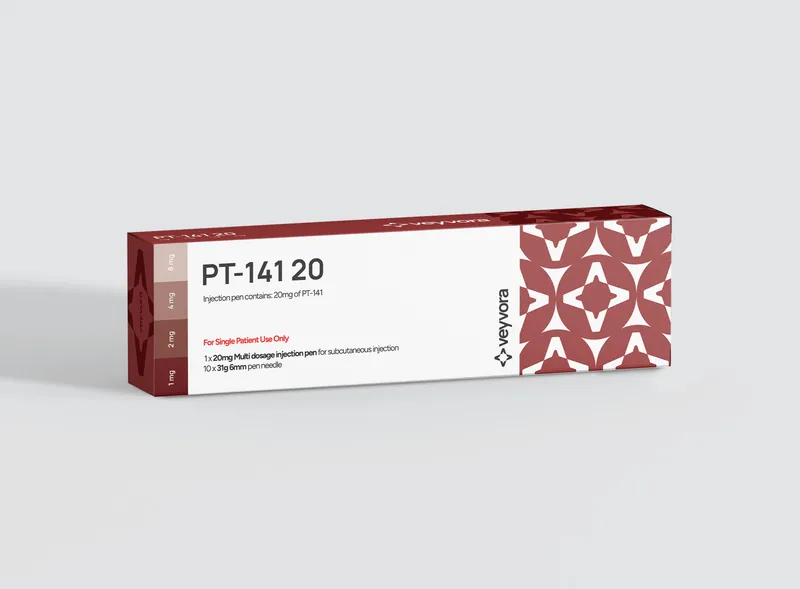
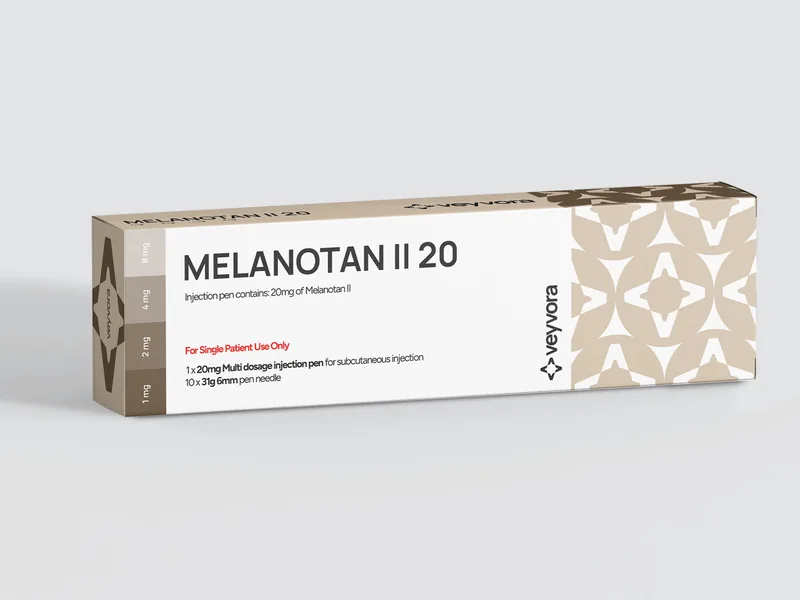
Melanocortin Receptor Agonists: PT-141 vs MT-II
PT-141 (bremelanotide) and Melanotan II (MT-II) are both cyclic heptapeptide melanocortin receptor agonists, but they differ in receptor coverage: PT-141 shows higher functional potency at MC3R and MC4R, while Melanotan II activates MC1R, MC3R, MC4R and MC5R non-selectively across overlapping concentration ranges [2]. That distinction determines which compound suits a given in-vitro research question. This page covers the receptor-coverage differences between the two compounds, the evidence quality underpinning each, and the documentation checks required before committing either material to an assay series. All materials and discussion on this page are for laboratory and in-vitro research use only.
Browse analytically documented, batch-numbered material on the PT-141 20 mg Bremelanotide Pen page or the Veyvora research peptides catalogue before reading further, then return here to calibrate your experimental design.
| Property | PT-141 (Bremelanotide) | Melanotan II (MT-II) |
|---|---|---|
| Receptor emphasis | MC4R-focused (higher potency at MC4R, with MC3R); MC1R activity present but lower | MC1R, MC3R, MC4R, MC5R (pan-melanocortin, non-selective) |
| Structural basis | Cyclic heptapeptide derived from MT-II scaffold; single-residue modification shifts selectivity | Lactam-bridged cyclic heptapeptide analogue of α-MSH(4–10) |
| Principal research trade-off | Reduced MC1R-driven pigmentation signal; more MC4R-weighted concentration–response | Broad receptor activation useful as reference or pan-agonist condition |
| Regulatory status (UK, as of August 2026) | No MHRA marketing authorisation; research reagent only | Treated by the MHRA as an unlicensed medicinal product; research reagent only |
| Evidence anchor | Phase 2/3 trial data and 2019 FDA multidiscipline review available; clinical data moderate-quality | No major regulatory assessment monograph; receptor pharmacology anchored in earlier binding datasets [2] |
IUPHAR/BPS records bremelanotide with low-nanomolar potency at MC4R and higher IC50 values at MC1R, consistent with a profile skewed towards central MC4R signalling rather than pigmentation pathways [1]. Melanotan II, by contrast, is characterised across the melanocortin pharmacology literature as a potent but non-selective reference agonist spanning the receptor family [2].
Key Takeaways
- PT-141 is MC4R-weighted; Melanotan II is a pan-melanocortin agonist spanning MC1R, MC3R, MC4R and MC5R. Choose between them based on which receptor subtypes your cell system expresses.
- The evidence base for PT-141 is comparatively deeper, anchored in a 2019 FDA multidiscipline review; Melanotan II pharmacology relies substantially on binding datasets from 1996 that predate modern biased-agonism frameworks.
- Head-to-head in-vitro comparisons at matched concentrations are sparse; selectivity statements in the literature are largely inferred from separate assay series and should be treated as hypothesis-generating.
- Both compounds are unlicensed for human use in the UK; procurement must be as research-grade reagents with batch-level LC-MS or HPLC documentation.
Direct Comparison: Receptor Coverage and Research Use
PT-141 shows higher functional potency at MC3R and MC4R with reduced MC1R activity, whereas Melanotan II is a non-selective pan-agonist active across MC1R, MC3R, MC4R and MC5R [2]. That receptor-coverage difference is the primary criterion for choosing between them in any in-vitro experimental design.
Bremelanotide’s low-nanomolar potency at MC4R and higher IC50 values at MC1R place it in the MC4R-weighted category, consistent with a profile oriented towards central signalling rather than pigmentation pathways [1]. Melanotan II occupies a different niche in 2024–2026 compound-evidence syntheses: a potent but non-selective reference agonist spanning the full melanocortin family, including MC5R, which is implicated in exocrine gland function [2].
Researchers selecting between the two compounds for receptor-pathway studies should treat PT-141 as the narrower MC4R-weighted option and MT-II as the broader pan-melanocortin reference condition. Confirming receptor subtype expression in the chosen cell system before interpreting concentration–response data from either compound is essential, because composite signalling from co-expressed subtypes will otherwise confound attribution. For PT-141 product specification and format details, see the PT-141 20 mg Bremelanotide Pen; for guidance on interpreting purity documentation, see what HPLC purity does and does not prove.
Identity and Mechanism Side by Side
PT-141 is a cyclic heptapeptide melanocortin analogue derived directly from the Melanotan II scaffold, modified at a single residue to shift selectivity towards MC3R and MC4R and reduce MC1R-driven pigmentation activity. Melanotan II is a lactam-bridged cyclic heptapeptide analogue of α-MSH(4–10), where α-MSH denotes alpha-melanocyte-stimulating hormone, designed as a conformationally constrained pan-agonist active across MC1R, MC3R, MC4R and MC5R [2]. Both compounds act within the class A Gs-coupled GPCR (G protein-coupled receptor) family, elevating intracellular cAMP (cyclic adenosine monophosphate) in receptor-expressing cells [1].
| Property | PT-141 (Bremelanotide) | Melanotan II |
|---|---|---|
| Structural class | Cyclic heptapeptide; MT-II-derived scaffold [2] | Cyclic heptapeptide; α-MSH(4–10) lactam analogue [2] |
| Primary receptor targets | MC3R, MC4R (higher potency); MC1R, MC5R (lower potency) [2] | MC1R, MC3R, MC4R, MC5R (non-selective) [2] |
| MC2R activity | Minimal [2] | Minimal [2] |
| Signalling mechanism | Gs-coupled cAMP elevation [1] | Gs-coupled cAMP elevation [1] |
| Selectivity profile | MC4R-weighted [2] | Pan-melanocortin reference agonist [2] |
| Pigmentation pathway relevance | Reduced (lower MC1R potency) [2] | Higher (potent MC1R agonism) [2] |
The single-residue modification distinguishing PT-141 from Melanotan II is pharmacologically consequential: it narrows the receptor engagement profile without eliminating cross-reactivity at MC1R entirely, so complete subtype selectivity cannot be assumed in any cell system expressing multiple melanocortin receptors [2]. Researchers should verify a batch against its CoA to confirm peptide identity before attributing receptor-specific effects to either compound, and should consult storage and stability guidance for research peptides to ensure material integrity between receipt and assay.
Evidence Strength and Limitations
The evidence base for PT-141 and Melanotan II differs substantially in depth, regulatory grounding and recency. Researchers should calibrate experimental expectations accordingly, starting with the strongest anchor for each compound before designing assays.
Bremelanotide’s MC4R-weighted pharmacology is supported by a comparatively well-documented regulatory record, including an FDA multidiscipline review completed in 2019, which characterised its receptor profile in detail. Melanotan II has no equivalent regulatory assessment monograph; its Ki and EC50 values, widely cited in mechanistic summaries, remain anchored in earlier binding datasets, notably Dorr et al. (1996), which predates modern biased-agonism frameworks and should be treated as potentially stale when designing 2026 assays [2].
For both compounds, quantitative receptor-binding and signalling data derive predominantly from heterologous cell systems and isolated tissue preparations. Published work from 2024 to 2026 has not applied signalling-kinetics or Gs-versus-β-arrestin bias frameworks to either peptide in any systematic way, so pathway-selectivity claims beyond cAMP elevation remain under-characterised and require empirical verification in the chosen model [2].
Independent head-to-head studies comparing PT-141 and Melanotan II at matched concentrations within the same in-vitro system are sparse; differential selectivity statements in the current literature are largely inferred from separate assay series conducted under different conditions, which limits direct interpretation. Treat such comparisons as hypothesis-generating rather than definitive [2].
No published evidence establishes the purity, identity or bioactivity of any particular commercial batch of either compound, so batch-level quality must be evaluated through in-house analytical and functional testing. Veyvora research peptides and Veyvora’s Vitality Research Pens are supplied for laboratory and in-vitro research use only; all materials on this page are discussed exclusively in that context.
Study-Design Implications
For in-vitro studies targeting specific melanocortin pathways, PT-141 suits research questions centred on MC3R/MC4R signalling with reduced MC1R-driven pigmentation read-outs, while Melanotan II is more appropriate when a broad pan-melanocortin activation profile is required as a reference or stressor condition [1].
Because Melanotan II activates MC1R, MC3R, MC4R and MC5R across overlapping concentration ranges, any cell system expressing multiple melanocortin subtypes will produce composite signalling. Experimental designs using Melanotan II therefore require receptor expression profiling, for example via qPCR (quantitative polymerase chain reaction) or immunoblot, alongside receptor-selective antagonists or knock-downs to disentangle subtype contributions [2].
PT-141’s MC4R-weighted potency allows concentration-response curves to engage MC4R robustly while keeping MC1R and MC5R contributions lower. Published Ki and IC50 values still indicate measurable PT-141 activity at MC1R, so complete selectivity must be verified empirically in the chosen model rather than assumed from the literature [1].
Both compounds are short peptides subject to proteolysis in serum-containing media. Time-course designs and pathway read-outs, including cAMP accumulation, CRE-reporter activation and downstream gene expression, should include stability controls and, where feasible, peptide-integrity assays to support valid exposure-response interpretation [2]. Researchers sourcing material for such work can review the full specification on the PT-141 20 mg Bremelanotide Pen page; for context on what analytical purity data can and cannot confirm about batch suitability, see what HPLC purity does and does not prove.
Material and Documentation Checks
In the UK, both PT-141 and Melanotan II are unlicensed for human use and must be procured strictly as research-grade materials. The MHRA treats Melanotan II as an unlicensed medicinal product, and bremelanotide holds no MHRA marketing authorisation as of August 2026; the US FDA’s 2019 approval of bremelanotide as Vyleesi does not extend to the UK or EU [3][4]. UK research entities must therefore treat all PT-141 and MT-II batches as experimental reagents, clearly distinguished from licensed medicinal products within institutional risk assessments and governance frameworks.
Procurement decisions should centre on analytical documentation rather than supplier marketing copy. Minimum documentation for either compound should include peptide identity confirmation via LC-MS (liquid chromatography–mass spectrometry) or HPLC (high-performance liquid chromatography) traces, a stated purity specification, and a batch-level certificate of analysis. Regulatory monographs equivalent to an EMA SmPC (European Medicines Agency Summary of Product Characteristics) or MHRA PAR (Public Assessment Report) are not available for research-only batches, so in-house verification is the only reliable quality gate. Supplier website statements about documentation practices do not constitute independent quality evidence.
Storage conditions, peptide form (for example, acetate salt or lyophilised powder), and any available stability data should appear in batch records. Researchers can verify a batch against its CoA and consult storage and stability guidance for research peptides before committing material to an assay series. All handling and disposal must follow institutional chemical and biological safety policies.
Related Individual Research Pages
Receptor-level context for any PT-141 vs Melanotan II comparison sits across several distinct resources, and knowing which to consult for which question saves time at the design stage. IUPHAR’s melanocortin receptor family page covers MC1R–MC5R endogenous ligands, signal transduction and nomenclature without drifting into clinical claims, making it the appropriate starting point for receptor-expression profiling decisions [1]. The melanocortin receptor pharmacology review and the FDA’s bremelanotide assessment supply receptor-affinity, assay-system and regulatory detail that extends the comparison beyond what a single article can cover [2][3].
For UK regulatory context, resources confirming both compounds are non-MHRA-authorised and restricted to laboratory and in-vitro research use are more reliable than community forums or dosing-advice pages, which should be avoided entirely [4]. Commercial product pages and neutral research primers serve different purposes and should be consulted separately rather than treated as equivalent sources of evidence.
Compound-specific background sits on the PT-141 research page and the Melanotan II research page. Researchers sourcing either compound for in-vitro work can review Veyvora’s Vitality Research Pens for batch-numbered, analytically documented material, or browse the wider Veyvora research peptides catalogue for the full range of research-use-only compounds. The concrete next step is to request the certificate of analysis for the specific batch under consideration and cross-reference it against the receptor-affinity data in the mechanistic guides before committing material to an assay series.
All materials and discussion on this page are for laboratory and in-vitro research use only.
Sources
[1] Melanocortin receptors, IUPHAR/BPS Guide to Pharmacology, https://www.guidetopharmacology.org/GRAC/FamilyDisplayForward?familyId=17 [2] Melanocortin receptor pharmacology (review), PMC, https://pmc.ncbi.nlm.nih.gov/articles/PMC11546340/ [3] Vyleesi (bremelanotide) approval, U.S. Food and Drug Administration, Drugs@FDA, 2019, https://www.accessdata.fda.gov/scripts/cder/daf/index.cfm?event=overview.process&ApplNo=210557 [4] Borderline products: how to tell if your product is a medicine, Medicines and Healthcare products Regulatory Agency (MHRA), GOV.UK, https://www.gov.uk/guidance/borderline-products-how-to-tell-if-your-product-is-a-medicine