
Key Takeaways
PT-141 (bremelanotide) and Melanotan II are related but distinct melanocortin research peptides. PT-141 is a deaminated derivative of Melanotan II with a research profile oriented towards MC4R (with secondary MC3R) central signalling, whereas Melanotan II activates a broader range of melanocortin receptor subtypes, MC1R, MC3R, MC4R and MC5R, and has been studied across pigmentation, appetite, autonomic and erectile endpoints. Melanotan II studies span receptor pharmacology from early human tanning and tolerability work through to animal and mechanistic investigations of hypothalamic c-Fos activation and spinal cord pathways: model systems that are not interchangeable with the HEK-293 expression assays and RigiScan erectile endpoints more commonly used in PT-141 research. Treating the two compounds as equivalent substitutes in a study design risks conflating receptor-selectivity profiles that the published literature distinguishes clearly, and any potency result generated in one assay system should not be assumed to transfer to another, particularly for centrally acting peptides. [1]
All materials discussed on this page are supplied by Veyvora strictly for in-vitro laboratory research use only. They are not medicines and are not intended for human or veterinary consumption.
What Vitality and Melanocortin Research Peptides Covers
This page covers three things: how PT-141 and Melanotan II differ as research tools, what analytical documentation each batch requires before laboratory use, and how to confirm current catalogue options with Veyvora.
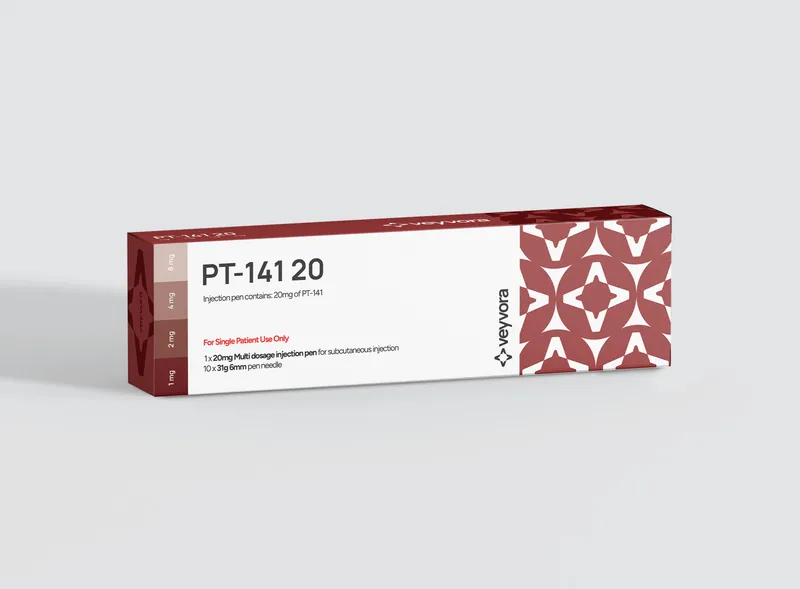
PT-141 (bremelanotide) is the vitality catalogue entity in this category, supplied by Veyvora strictly for in-vitro laboratory research use only, with a research profile centred on MC4R (and secondary MC3R) central signalling pathways. Melanotan II is included here only as a receptor-selectivity reference point: a broader, non-selective melanocortin agonist whose published study endpoints span pigmentation, appetite, autonomic responses and erectile physiology across multiple receptor subtypes. It is stocked under Veyvora’s aesthetics range, not vitality.
The category boundary is defined by receptor pharmacology and assay context. Researchers selecting between these compounds should do so on the basis of which receptor subtype and model system their study requires, consulting the batch-specific certificate of analysis (CoA) before first use. The PT-141 20 mg Bremelanotide Pen product page carries current catalogue details, and the how to verify your batch page provides the procedure for matching a batch number to its documentation prior to laboratory use.
Research Areas and Catalogue Entities
PT-141 (bremelanotide) is the verified catalogue entity within this category. Melanotan II (MT-II) appears below only as a receptor-selectivity comparison reference; Veyvora stocks it under its aesthetics range, not vitality. Both are supplied by Veyvora for in-vitro laboratory research use only and are not medicines or materials for human or veterinary consumption (Veyvora, 2026).
PT-141 (Bremelanotide)
PT-141 is the primary catalogue entity, and its published research profile centres on MC4R (with secondary MC3R) central signalling. In-vitro work is commonly conducted in HEK-293 receptor-expression systems and hypothalamic activation models. The PT-141 20 mg Bremelanotide Pen product page carries current catalogue details; each pen ships with a batch-specific CoA, and its fields should be confirmed against the certificate before procurement.
Melanotan II (MT-II)
MT-II appears here only as a receptor-selectivity reference compound; Veyvora stocks it under its aesthetics range, not vitality. The peer-reviewed literature describes MT-II as a non-selective melanocortin agonist with activity spanning MC1R, MC3R, MC4R and MC5R. Studies have used rodent intrathecal and intracerebral models, rabbit cavernosal tissue preparations, and quantitative reflectance endpoints, making MT-II a broad melanocortin probe rather than a selective research tool for any single receptor subtype.
Analytical Verification for Both Entities
ICH Q6A states that identification by a single chromatographic retention time alone is not regarded as specific, and that HPLC (high-performance liquid chromatography) combined with mass spectrometry is generally acceptable for identity confirmation [1]. HPLC provides a purity read-out, mass spectrometry confirms identity, and endotoxin testing addresses contamination that HPLC cannot detect, three distinct questions that a CoA must answer separately [1]. See what HPLC purity does and does not prove for the fuller interpretive framework, and consult storage and stability guidance for handling requirements applicable to these catalogue formats.
Compare the Research Roles
PT-141 carries a C-terminal carboxylate modification absent in MT-II, and the published literature associates PT-141 more closely with MC3R/MC4R-oriented central nervous system (CNS) models, whereas MT-II is a non-selective agonist active across MC1R, MC3R, MC4R and MC5R in broader receptor panels. That structural and selectivity difference is the primary reason the two compounds are not interchangeable in a study design.
| Criterion | PT-141 / Bremelanotide | Melanotan II (MT-II) |
|---|---|---|
| Chemical relationship | Deaminated/carboxylate derivative of MT-II | Cyclic α-MSH analogue; parent structure |
| Primary receptor emphasis | MC3R and MC4R (central CNS signalling) | MC1R, MC3R, MC4R, MC5R (non-selective) |
| Typical assay systems cited in literature | HEK-293 receptor-expression assays; hypothalamic c-Fos activation; intranasal/subcutaneous pharmacokinetic models | Rodent intrathecal and intracerebral preparations; rabbit cavernosal tissue; quantitative reflectance endpoints |
| Research endpoints reported | Hypothalamic activation; erectile physiology (RigiScan); CNS melanocortin pharmacokinetics | Pigmentation; appetite and energy balance; yawning/stretching; autonomic effects; penile erection |
| Selectivity as a research probe | Relatively cleaner MC4R/MC3R probe for CNS-focused questions | Broader melanocortin probe; not selective for any single receptor subtype |
| Veyvora catalogue format | Pre-filled 3 mL solution pen (PT-141 20 mg); confirm per-click dose on the product page | Stocked under the aesthetics range as a pre-filled 3 mL solution pen (Melanotan II 20 mg); see aesthetics |
| Batch documentation | Batch-specific CoA ships with each pen; confirm fields against the certificate (Veyvora, 2026) | Batch-specific CoA ships with each pen; confirm fields against the certificate (Veyvora, 2026) |
| Analytical standard | HPLC purity + MS identity + endotoxin assay, per ICH Q6A [1] | HPLC purity + MS identity + endotoxin assay, per ICH Q6A [1] |
Selecting between the two compounds should follow the assay system and receptor question, not assumed interchangeability, because expression-system binding data and tissue or behavioural read-outs do not transfer one-to-one across model types. Consult Veyvora’s research-peptide catalogue for current format options, and the research-peptide glossary for definitions of receptor nomenclature and assay terminology used in this comparison.
Key Takeaways
- PT-141 and Melanotan II differ structurally and in receptor selectivity: PT-141 is a relatively cleaner MC3R/MC4R probe; MT-II is non-selective across MC1R, MC3R, MC4R and MC5R.
- The assay systems used in the published literature are not interchangeable — HEK-293 expression assays for PT-141, rodent intrathecal and cavernosal tissue models for MT-II — so potency data should not be assumed to transfer between them.
- Every batch requires three distinct CoA fields before laboratory use: an HPLC purity figure, a mass spectrometry identity result, and a separate endotoxin value, per ICH Q6A [1].
- Regulatory obligations for UK procurement depend on local medicines law and any import or manufacturing permissions actually held; confirm your institution’s position before ordering.
- All materials are supplied for in-vitro laboratory research use only and are not medicines or material for human or veterinary consumption.
Evidence Boundaries
The published evidence base for PT-141 and Melanotan II spans three distinct tiers: mechanistic in-vitro binding data, preclinical animal models, and early-phase human pharmacokinetic or pharmacodynamic studies. Conclusions from one tier do not transfer automatically to another, and researchers should treat selectivity rankings as provisional where older studies use differing assay systems and reporting conventions that are not directly comparable [1].
Mechanistic and In-Vitro Evidence
Receptor-binding and cAMP assays conducted in expression systems such as HEK-293 cells establish affinity and relative potency at defined receptor subtypes under controlled conditions. Because ICH Q6A confirms that identification by a single chromatographic retention time is insufficient and that combinations such as HPLC with mass spectrometry are required for identity confirmation, a purity figure from HPLC alone cannot substitute for identity or contamination data [1]. Batch certificates should therefore be read with all three assay fields present before first use; researchers can confirm batch-level documentation via how to verify your batch.
Preclinical and Clinical Evidence
Rodent and non-human primate studies of Melanotan II and PT-141 report endpoints including hypothalamic c-Fos activation, intracavernosal pressure and grooming responses; these are model-specific read-outs and do not predict equivalent outcomes in other species or assay systems. Early human pharmacokinetic work with PT-141 used intranasal and subcutaneous routes with RigiScan endpoints, and those designs are not interchangeable with in-vitro receptor data.
Laboratory Procurement Checks
Before ordering PT-141 or Melanotan II for in-vitro research, confirm that the supplier’s CoA carries three distinct assay fields: an HPLC purity figure, a mass spectrometry identity result, and a separate endotoxin value. ICH Q6A states that identification by a single chromatographic retention time is not regarded as specific, and that combinations such as HPLC/MS are generally acceptable for identity confirmation [1]. A CoA that omits any one of those fields leaves a verification gap that no supplier statement can close; see what HPLC purity does and does not prove for a fuller explanation of what each assay field does and does not establish.
Regulatory and Documentation Checks
In the UK, supplying human medicines to anyone other than the patient generally requires a wholesale distribution authorisation from the MHRA (Medicines and Healthcare products Regulatory Agency) [2]. Laboratory-use-only peptides such as PT-141 and Melanotan II sit outside human-use claims, but distributor obligations depend on local medicines law and any import or manufacturing permissions actually held; confirm your institution’s position before procurement.
Handling and Cold-Chain Verification
Veyvora states that orders are dispatched under documented cold-chain conditions in an insulated bag with a gel ice pack (Veyvora, 2026). No product-specific stability dataset for PT-141 or Melanotan II was available for independent review at the time of writing, so treat cold-chain handling as a supplier logistics claim requiring verification against your own stability requirements. Consult storage and stability guidance and confirm batch-specific conditions with the supplier before first use.
Related Research and Comparison Pages
Researchers who have assessed the receptor-selectivity distinction between PT-141 and Melanotan II, reviewed batch documentation requirements, or confirmed regulatory obligations are best served by moving directly to a specific next resource. For a full head-to-head treatment of the two compounds, see the PT-141 vs Melanotan II comparison.
Veyvora’s research-peptide catalogue is the appropriate starting point for procurement decisions: it lists current catalogue entities, batch-specific CoA availability, and storefront options across GBP, EUR, CZK and ZAR. Confirm PT-141 and Melanotan II product pages directly there, as prices, stock status and format options require live verification against current listings rather than any static article.
For terminology used in the receptor pharmacology and assay sections above, including MC3R, MC4R, HPLC purity, mass spectrometry identity confirmation and endotoxin assay, the research-peptide glossary provides definitions scoped to laboratory and in-vitro research contexts.
Your Concrete Next Step
Download the batch-specific CoA for the catalogue lot you are considering by quoting the batch number directly to Veyvora, then cross-check the three fields that answer distinct questions: HPLC purity, mass spectrometry identity, and endotoxin value [1]. Where any field is absent, request a revised CoA before proceeding; no supplier statement substitutes for the assay result itself.
All materials discussed on this page are supplied strictly for in-vitro laboratory research use only and are not medicines or material for human or veterinary consumption (Veyvora, 2026).
Sources
[1] database.ich.org, https://database.ich.org/sites/default/files/Q6A%20Guideline.pdf [2] Welcome to GOV.UK, gov.uk, https://www.gov.uk/guidance/apply-for-manufacturer-or-wholesaler-of-medicines-licences