
Key Takeaways
This page covers what BPC-157 and TB-500 are as synthetic reference materials, how their research mechanisms differ, what the current evidence base shows, and what UK laboratories should verify before procurement. All materials discussed are for laboratory and in-vitro research use only.
- BPC-157 and TB-500 address distinct points in the repair cascade and are not interchangeable within a protocol.
- The evidence base for both materials is predominantly preclinical; in-human safety and efficacy remain unknown for each.
- Batch-specific CoA documentation covering peptide sequence, HPLC purity, mass spectrometry identity and endotoxin screen is required before any material enters a protocol.
BPC-157 is a stable gastric pentadecapeptide studied in cell cultures and animal models for reported effects on angiogenesis, collagen synthesis and nitric oxide (NO) signalling. TB-500 is a synthetic fragment related to thymosin β4, examined for its role in actin reorganisation, endothelial cell migration and stem cell recruitment. Neither holds Medicines and Healthcare products Regulatory Agency (MHRA) or European Medicines Agency (EMA) marketing authorisation for any human medicinal application.
A 2025 orthopaedic systematic review identified 39 eligible BPC-157 studies spanning 1993–2024, of which 35 were preclinical [2]. That ratio defines the evidence base: these are research tools for modelling repair pathways, not clinical products. Veyvora’s category is built around that distinction, presenting BPC-157 and TB-500 as complementary reference materials for laboratories investigating tissue-repair mechanisms at the cellular and preclinical level.
Browse the repair and recovery range to compare available batch documentation across the category, or visit Veyvora’s research-peptide catalogue to review the full range of reference materials and supplier quality documentation.
What Repair & Recovery Research Peptides Covers
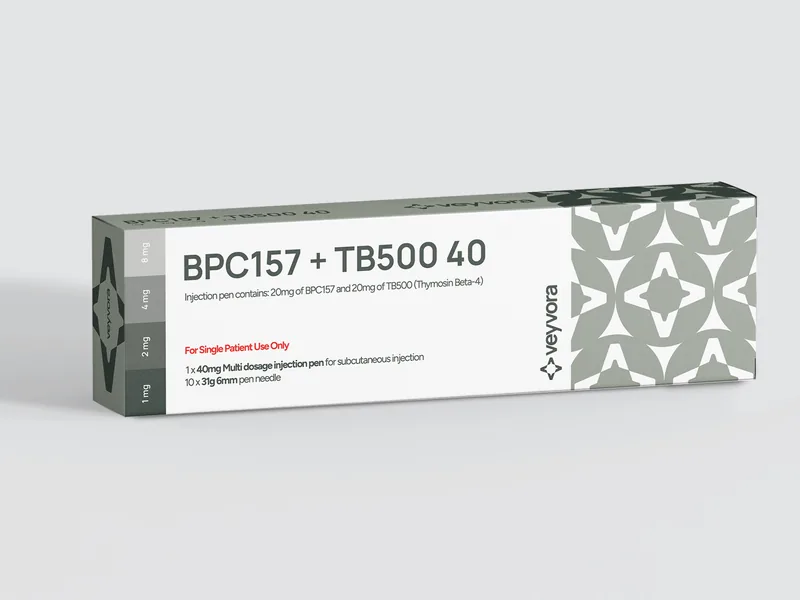
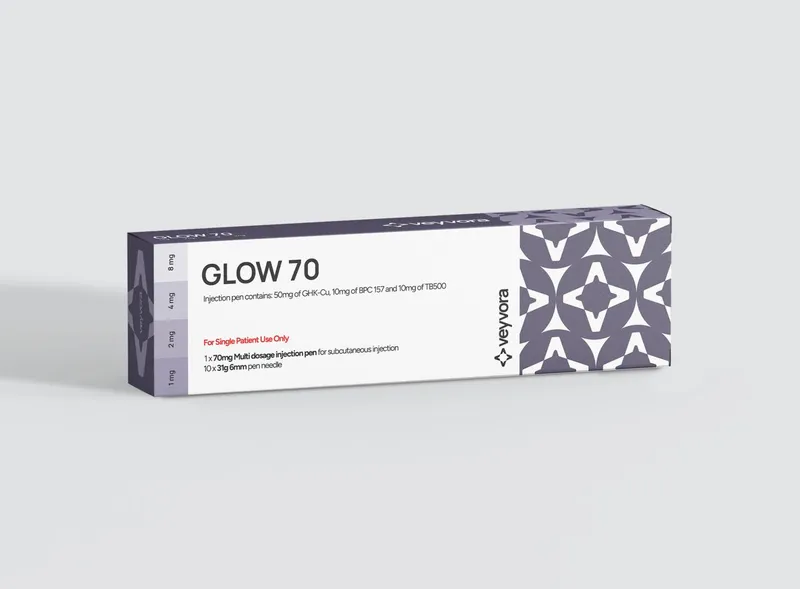
Veyvora’s Repair & Recovery Research Peptides category supplies BPC-157 and TB-500 together in a single combined research pen for laboratory and in-vitro research into tissue-repair mechanisms, including angiogenesis, collagen synthesis, fibroblast activity and cell migration.
BPC-157 is examined across musculoskeletal, gastrointestinal and vascular injury models. TB-500 is studied for its role in stem cell recruitment, actin reorganisation and anti-fibrotic remodelling. The 2025 orthopaedic systematic review’s finding that 35 of 39 eligible BPC-157 studies were preclinical [2] defines the category’s evidence boundary: these are research tools for modelling repair pathways, not clinical products.
Researchers comparing the two peptides at the mechanism level can consult the BPC-157 versus TB-500 comparison for a structured pathway analysis. Before interpreting any purity figure from a certificate of analysis (CoA), the resource on what HPLC purity does and does not prove sets out the analytical limits that apply to both materials.
Research Areas and Catalogue Entities
Veyvora supplies BPC-157 and TB-500 together as a single combined research pen, the BPC-157 + TB-500 40 mg pen. The two peptides act through distinct, complementary pathways, which is the rationale for combining them in one pen rather than stocking them as separate SKUs.
BPC-157
BPC-157 is a stable gastric pentadecapeptide investigated across musculoskeletal, gastrointestinal and vascular injury models, with preclinical research examining reported effects on angiogenesis, collagen synthesis, fibroblast proliferation and NO signalling [2]. The 2025 orthopaedic systematic review identified 39 eligible studies spanning 1993–2024, of which 35 were preclinical and only one was clinical; the authors concluded that in-human safety and therapeutic value remain unknown [2]. Within this catalogue, BPC-157 is a tool for interrogating local tissue resilience, tendon-ligament junction repair and gastrointestinal mucosal healing in cell and animal models.
TB-500
TB-500 is a synthetic fragment related to thymosin β4, studied for its role in actin reorganisation, endothelial cell migration, stem and progenitor cell homing, and anti-fibrotic remodelling. Preclinical models have applied TB-500 to cardiac, dermal, corneal and musculoskeletal repair contexts, with a focus on upstream recruitment and vascularisation signalling rather than localised cytoprotection. A 2026 scoping review on thymosin β4 and related fragments reported promising tissue-repair signals across animal models but highlighted major gaps in standardisation and a sparse, methodologically heterogeneous clinical trial base.
These two entities are distinct in primary mechanism and target tissue profile and should not be treated as interchangeable within a research protocol. Formulation details, including the pre-filled solution-pen specification and confirmed purity figures, must be drawn from the batch-specific CoA rather than assumed from category-level descriptions. Researchers should verify a batch against its CoA before use and consult storage and stability guidance to confirm cold-chain requirements for each material.
Compare the Research Roles
BPC-157 and TB-500 address different points in the repair cascade and should be selected on the basis of the specific mechanism under investigation.
| Criterion | BPC-157 | TB-500 |
|---|---|---|
| Structural identity | Stable synthetic pentadecapeptide derived from gastric juice protein | Synthetic fragment related to thymosin β4 |
| Primary research mechanism | Local cytoprotection; focal adhesion kinase–paxillin signalling; NO pathway modulation; growth hormone receptor upregulation [2] | Actin reorganisation; endothelial cell migration; stem and progenitor cell homing; anti-fibrotic remodelling |
| Predominant preclinical models | Tendon–ligament junction repair, gastrointestinal mucosal healing, musculoskeletal and vascular injury [2] | Post-infarct cardiac repair, dermal wound closure, corneal and musculoskeletal regeneration |
| Evidence tier (as of 2025–2026) | 35 of 39 eligible studies preclinical (1993–2024); one clinical study identified; in-human safety unknown [2] | Promising preclinical signals; clinical trial base described as sparse and methodologically heterogeneous |
| Typical format | Supplied together in one pre-filled 3 mL solution pen; confirm purity from batch CoA before use | Supplied together in one pre-filled 3 mL solution pen; confirm purity from batch CoA before use |
| Batch documentation | Batch-specific CoA required; values not transferable between lots | Batch-specific CoA required; values not transferable between lots |
BPC-157 acts locally as a cytoprotective model suited to interrogating junction repair and mucosal resilience at the injury site [2], whereas TB-500 operates further upstream, making it the more appropriate tool for studying systemic recruitment, vascularisation and fibrosis limitation. The two peptides can function as complementary models within a preclinical programme — BPC-157 for localised tissue response, TB-500 for recruitment and remodelling — provided any combined or sequential use remains strictly mechanistic and non-clinical, with no extrapolation to human outcomes.
Evidence Boundaries
The evidence base for both BPC-157 and TB-500 is predominantly preclinical, and this distinction carries direct consequences for how laboratory researchers should frame protocols and interpret results.
The 2025 orthopaedic systematic review found that 35 of 39 eligible BPC-157 studies were preclinical and only one was clinical, with the authors concluding that in-human safety and therapeutic value remain unknown [2]. The 2026 scoping review on thymosin β4 and related fragments reported promising tissue-repair signals across animal models but highlighted major gaps in standardisation alongside a sparse, methodologically heterogeneous clinical trial base.
Preclinical findings, such as changes in collagen deposition, angiogenic marker expression and fracture callus quality, describe mechanistic signals in cell and animal models, not clinical efficacy, safety or tolerability in humans. Neither BPC-157 nor TB-500 holds MHRA or EMA marketing authorisation for any human indication.
HPLC purity alone does not confirm identity, concentration or cold-chain integrity across lots; mass spectrometry identity confirmation and an endotoxin screen should also appear in the CoA before any material enters a protocol. The HPLC purity explainer sets out these analytical limits in full.
Laboratory Procurement Checks
UK laboratories procuring BPC-157 and TB-500 in 2026 should prioritise identity confirmation, batch-specific documentation and regulatory labelling before any other consideration. Materials must carry explicit “for research use only” labelling and must not be accompanied by therapeutic or human-use claims; MHRA has confirmed it will disregard research-purposes labelling where the promotional context implies medicinal use [3]. BPC-157 and TB-500 are unscheduled under the Misuse of Drugs Act 1971 as of early 2026, but that status does not reduce the obligation for rigorous internal quality control [4].
Documentation and Identity Checks
A batch-specific CoA should confirm four elements before any material enters a protocol:
- Peptide sequence
- HPLC purity percentage
- Mass spectrometry identity match
- Endotoxin screen result
All four data points should appear together and match the batch number on the vial, because HPLC purity alone does not establish identity, concentration or cold-chain integrity. Use Veyvora’s batch verification tool to cross-reference the batch number against the published CoA document before first use.
Cold-Chain and Storage
Repair-range peptides require continuous 2–8 °C storage; any gap in the cold chain between dispatch and receipt can compromise structural integrity in ways that purity figures will not detect. On arrival, check that the insulated bag and gel ice pack are intact and the parcel still feels cold, and record the result before opening the packaging; a warm parcel or compromised packaging warrants quarantining the batch and notifying the supplier before use. Veyvora’s storage and stability guidance covers the full handling procedure, including cold-chain packaging inspection on receipt.
Related Research and Comparison Pages
Researchers who have assessed the repair-range procurement criteria above will typically need one of the following next steps: a deeper mechanistic profile of a single peptide, a structured side-by-side comparison of BPC-157 and TB-500, or a route back to the full catalogue to assess other reference materials.
Individual peptide pages cover the evidence in greater depth than a category overview can. The BPC-157 research page addresses tendon-ligament junction data, gastrointestinal mucosal models and NO pathway modulation in isolation. The TB-500 research page focuses on thymosin β4 biology, cardiac post-infarct repair, wound-closure kinetics and fibrosis markers. A structured BPC-157 versus TB-500 comparison contrasts peptide structure, primary signalling pathways, typical preclinical models and evidence maturity, explicitly noting that BPC-157’s in-human safety and efficacy remain unknown and that TB-500’s clinical trial base is sparse and methodologically heterogeneous as of 2025–2026 [2].
All pages in this section carry explicit research-use-only labelling and link to regulatory context, including MHRA guidance on research-purposes framing [3]. Browse the repair and recovery range to compare available batch documentation across the category, or visit Veyvora’s research-peptide catalogue to review the full range of reference materials and supplier quality documentation.
Sources
[2] Emerging Use of BPC-157 in Orthopaedic Sports Medicine: A Systematic Review, HSS Journal, 2025, pubmed.ncbi.nlm.nih.gov, https://pubmed.ncbi.nlm.nih.gov/40756949/ [3] Borderline products: how to tell if your product is a medicine — GOV.UK (MHRA), gov.uk, https://www.gov.uk/guidance/borderline-products-how-to-tell-if-your-product-is-a-medicine [4] Misuse of Drugs Act 1971, legislation.gov.uk, https://www.legislation.gov.uk/ukpga/1971/38/contents
complete the stack.
bundle & save
Recovery Stack
Tissue repair by day, growth-hormone support overnight.
 BPC-157 + TB-500 40
CJC-1295 + Ipamorelin 20
BPC-157 + TB-500 40
CJC-1295 + Ipamorelin 20