
BPC-157 vs TB-500
The two most-studied tissue-repair peptides are frequently framed as alternatives, but in the research they map to different pathways — which is exactly why they're so often combined rather than chosen between.
two different pathways
BPC-157 is a synthetic pentadecapeptide studied in cytoprotection and angiogenesis-related repair — tissue protection and new blood-vessel formation. TB-500, a thymosin β4-related peptide, is studied for associations with actin regulation and cell migration — the cytoskeletal machinery cells use to move. Different mechanisms, not competing versions of one.
why 'complementary' is the key word
Because the pathways are complementary rather than overlapping, combining the two lets a single research model examine both at once. That's the reasoning behind pairing them — not that one is stronger than the other.
read each on its own
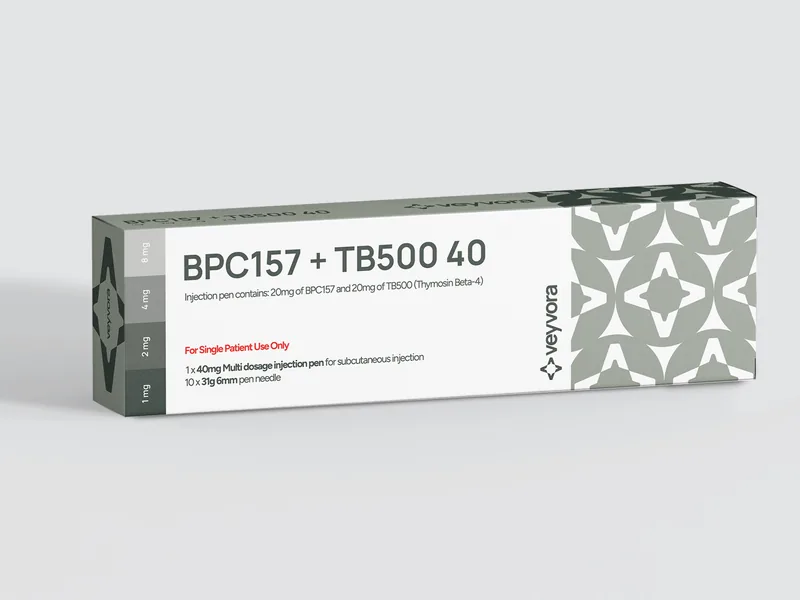
For the compound-level detail, see BPC-157 and TB-500. Both are supplied together in the BPC-157 + TB-500 research pen.
verifying the blend
For a two-compound pen, the certificate of analysis should confirm each component's identity and proportion — see how to read a CoA. More in the repair & recovery range.
research use only
Both compounds are supplied strictly for in-vitro and laboratory research use only — not medicines, not for human or veterinary consumption. Nothing here is dosing, medical or treatment guidance.
the research pens
Pre-filled, batch-numbered and independently assayed. Save one to your list and we'll email you the moment it's available in your country.
Overview
What this page covers: how BPC-157 and TB-500 differ in sequence, proposed pathway and evidence depth; what those differences mean for model and endpoint selection; and what analytical documentation to request before accepting a batch for in-vitro work.
BPC-157 and TB-500 are distinct research peptides with different sequences, different proposed laboratory mechanisms and non-interchangeable evidence bases. BPC-157 is a synthetic pentadecapeptide studied in relation to cytoprotection and angiogenesis-associated signalling in non-clinical models, while TB-500 is a short thymosin β4-related fragment studied in relation to actin dynamics and cell migration. Substituting one for the other in an in-vitro protocol is a change of test article, not a like-for-like swap.
Both are classified as tissue repair peptides in the research literature, yet that label describes a broad investigational category rather than a shared mechanism. The decision between these two research peptides should rest on pathway relevance, confirmed material identity and documented batch quality, not on catalogue proximity or combined marketing language.
All materials and discussion on this page are for laboratory and in-vitro research use only. No human treatment, administration or dosing information is provided or implied.
Browse Veyvora’s Repair & Recovery research peptides to inspect available formats once the pathway decision is confirmed.
Key takeaways:
- BPC-157 and TB-500 probe distinct cellular pathways and are not interchangeable reagents, even when grouped under the same catalogue category.
- Evidence generated with full-length thymosin β4 (43 residues) does not transfer to the short TB-500 fragment; only studies using the same sequence and terminal modification are fragment-relevant.
- HPLC area-percent purity does not confirm sequence, chirality or counter-ion identity; mass spectrometry and endotoxin testing are orthogonal requirements.
| Criterion | BPC-157 | TB-500 |
|---|---|---|
| Research identity | Synthetic pentadecapeptide (GEPPPGKPADDAGLV) | Short thymosin β4-related actin-binding fragment |
| Proposed pathway | Cytoprotection, angiogenesis-related signalling | Actin regulation, cell migration, cytoskeletal assays |
| Evidence depth | Largely preclinical; rodent and non-human models [1] | Fragment-specific literature limited; full-length Tβ4 evidence does not transfer directly [1] |
| Identity verification | Sequence and salt form must be confirmed per batch | Sequence, N-terminal modification and length must be confirmed per batch |
| Cold-chain | Confirm with supplier for specific product and destination | Confirm with supplier for specific product and destination |
Direct Comparison
BPC-157 is a synthetic pentadecapeptide (sequence: GEPPPGKPADDAGLV) studied in non-clinical models in relation to cytoprotection and angiogenesis-associated signalling, while TB-500 is a short thymosin β4-related fragment studied in relation to actin regulation and cell migration. The two peptides differ in sequence, molecular target class and literature base, and are not interchangeable reagents [1].
Selecting between these two research peptides requires matching each compound’s proposed pathway to the assay endpoint, then confirming material identity at the batch level. Catalogue proximity or combined marketing language does not constitute analytical equivalence. Understanding how HPLC purity does and does not prove identity is a necessary step before interpreting any supplier-issued purity figure for either compound.
| Criterion | BPC-157 | TB-500 |
|---|---|---|
| Sequence | GEPPPGKPADDAGLV (15 residues) | Short Tβ4-related actin-binding fragment |
| Proposed assay pathway | Cytoprotection, angiogenesis-related signalling | Actin dynamics, cell migration, cytoskeletal assays |
| Evidence base | Largely preclinical; rodent and non-human models [1] | Fragment-specific literature limited; full-length Tβ4 evidence does not transfer directly [1] |
| Identity verification priority | Sequence and salt form per batch | Sequence, N-terminal modification and fragment length per batch |
Identity and Mechanism Side by Side
BPC-157 and TB-500 probe different cellular pathways; treating them as interchangeable research reagents misrepresents both their molecular targets and their evidence bases [1].
BPC-157 (sequence: GEPPPGKPADDAGLV, 15 residues) is a synthetic gastric-derived pentadecapeptide. In non-clinical models, researchers have studied it in relation to cytoprotective signalling and angiogenesis-associated processes, including nitric-oxide pathway modulation and VEGF-linked readouts [1]. TB-500 is a short thymosin β4-related fragment, commonly described as the actin-binding motif peptide Ac-LKKTETQ. Its proposed laboratory role centres on G-actin dynamics, cytoskeletal reorganisation and cell-migration assays. Because the fragment retains only the actin-binding motif of the parent protein, evidence generated with intact thymosin β4 (43 residues, multiple functional domains) does not transfer to TB-500: multi-domain structure-function results, nuclear localisation findings and full-protein pharmacokinetic data belong to the intact chain, not to the fragment [1].
| Criterion | BPC-157 | TB-500 |
|---|---|---|
| Sequence | GEPPPGKPADDAGLV (15 residues) | Short Tβ4-related actin-binding fragment (verify exact sequence and terminal modification per batch) |
| Molecular weight | ~1,419 Da (verify per batch MS) | Verify per batch MS; N-terminal acetylation affects mass |
| Proposed assay pathway | Cytoprotection, angiogenesis-related signalling | Actin dynamics, cell migration, cytoskeletal assays |
| Evidence base | Largely preclinical; rodent and non-human models [1] | Fragment-specific literature limited; intact Tβ4 evidence does not transfer directly [1] |
| Identity verification priority | Sequence and salt form per batch | Sequence, N-terminal modification and fragment length per batch |
| Cold-chain and storage | Confirm with supplier handling documentation | Confirm with supplier handling documentation |
Where an assay endpoint involves both cytoprotective and cytoskeletal readouts, the two peptides may address complementary pathways in separate experimental arms. Complementary here means distinct proposed mechanisms, not a rationale for combined administration or additive human benefit. Consult storage and stability guidance for research peptides before committing either material to a protocol.
Evidence Strength and Limitations
BPC-157 and TB-500 occupy different positions on the evidence hierarchy, and conflating their respective bodies of literature produces unreliable protocol assumptions.
BPC-157: Where the Evidence Sits
BPC-157 research is dominated by rodent and other non-human animal models, with endpoints such as lesion scores, histological repair markers and angiogenesis-related readouts [1]. Independent replication across separate research groups remains limited, and the literature is concentrated within a small number of laboratories. Proposed mechanisms, including nitric-oxide pathway modulation and VEGF-linked angiogenic signalling, remain hypothesis-level in the absence of confirmed material identity alongside the reported endpoint [1]. Human in-vitro characterisation is sparse relative to the animal-model corpus, and a published result does not guarantee that a 2026 commercial batch will reproduce the endpoint; sequence, salt form and impurity profile must match the reagent described in the methods.
TB-500: The Fragment-Protein Distinction
The TB-500 evidence base is narrower still. Full-length thymosin β4 (43 residues) has a deeper literature covering G-actin sequestration, cytoskeletal reorganisation and cell-migration assays, but those findings do not transfer to a short acetylated fragment because the fragment lacks the additional functional domains present in the intact protein [1]. Only studies that used the same sequence, terminal modification and analytically confirmed identity as the TB-500 reagent under evaluation can be cited as fragment-relevant evidence. Nuclear localisation findings, whole-protein pharmacokinetics and multi-domain receptor-interaction data are intact-Tβ4 results, not TB-500 results.
Analytical documentation adds a further layer of limitation. HPLC area-percent purity confirms chromatographic separation but does not prove sequence, chirality or counter-ion identity; mass spectrometry supports molecular mass and, with MS/MS, partial sequence, yet neither method confirms biological activity or endotoxin absence. Endotoxin testing is orthogonal to chromatographic purity and is particularly relevant for endotoxin-sensitive in-vitro systems. For a detailed account of how purity figures should be interpreted, consult how HPLC purity does and does not prove identity before reviewing batch certificates.
Study-Design Implications
Model selection for BPC-157 and TB-500 research must be driven by the pathway each reagent is proposed to engage, not by a general assumption that both compounds suit the same assay format. BPC-157 research has historically used rodent lesion and histological-repair models alongside angiogenesis-related tube-formation and cell-viability assays; TB-500 work, where it uses the short actin-binding fragment rather than full-length thymosin β4, is more appropriately matched to cell-migration, wound-scratch and cytoskeletal-reorganisation readouts [1]. Selecting a model designed for one pathway and applying it to the other produces data that cannot be interpreted as evidence for either compound’s proposed mechanism.
Matching Endpoints to Confirmed Identity
Before running any assay, the reagent’s confirmed sequence and modification must match the material described in the methods of the reference study being replicated or extended. An endpoint generated with full-length Tβ4 is not a valid comparator for a TB-500 fragment assay, and a rodent in-vivo lesion score is not a direct proxy for an in-vitro cytoprotection endpoint. Researchers should verify a batch against its CoA before first use to confirm that the batch number, sequence and purity on the certificate correspond to the material in hand.
Cold-Chain and Stability as Experimental Variables
Peptide degradation between dispatch and assay is a confounding variable that model selection alone cannot control. Temperature excursions alter peptide integrity, so observed endpoint variability may reflect handling artefact rather than a genuine biological signal. Consulting storage and stability guidance for research peptides before designing a multi-timepoint experiment reduces that risk.
Material and Documentation Checks
A batch certificate of analysis (CoA) is the starting point for any BPC-157 or TB-500 procurement decision: it documents that specific batch, so match the batch number to the certificate before use. HPLC area-percent purity confirms chromatographic profile; it does not prove sequence, chirality, counter-ion identity or the absence of related substances. Mass spectrometry, preferably with MS/MS fragmentation, supports molecular mass and partial sequence confirmation but is orthogonal to endotoxin status.
What to Request Before Accepting a Batch
For each compound, request the following before use:
- Batch number cross-referenced against the CoA on file
- Confirmed sequence and any terminal modifications (for example, N-acetylation in TB-500 material)
- HPLC purity trace with stated method and column conditions
- Mass-spectrometry data confirming molecular mass, with MS/MS where available
- Bacterial endotoxin result (LAL or recombinant Factor C), particularly where the intended in-vitro system is endotoxin-sensitive
- Cold-chain documentation confirming temperature maintenance from dispatch to receipt
Every Veyvora research pen ships with an independent, batch-specific certificate of analysis; check the batch number on the pen against the certificate before use. Researchers can verify a batch against its CoA before first use.
Regulatory Framing
In the UK, unlicensed peptides offered with medicinal claims fall under the Human Medicines Regulations 2012 and MHRA oversight [3]. Research-use-only labelling does not permit human administration advice or therapeutic presentation. Import status varies by destination and should be confirmed independently.
Researchers comparing BPC-157 and TB-500 material can browse Veyvora’s Repair & Recovery research peptides to inspect available formats, or begin at the Veyvora research peptides catalogue for full provenance and documentation details.
Related Individual Research Pages
The most productive next step after working through this comparison is confirming analytical identity before committing to an experimental design. Veyvora’s guide on how HPLC purity does and does not prove identity provides the deeper analytical explanation needed to interpret purity data correctly: an HPLC area-percent figure does not confirm sequence, chirality or counter-ion, and treating it as complete identity evidence is a common source of assay error. Once a batch is selected, verify it against its CoA to match the batch number to its published certificate before first use. Compound-level background sits on the individual BPC-157 research page and TB-500 research page, while the full catalogue (available formats and provenance documentation for both research materials) is accessible at the Veyvora research peptides homepage.
Sources
[1] PubMed, pmc.ncbi.nlm.nih.gov, https://pmc.ncbi.nlm.nih.gov/articles/PMC7614751/ [3] Medicines and Healthcare products Regulatory Agency - GOV.UK, legislation.gov.uk, https://www.legislation.gov.uk/uksi/2012/1916/contents