
CJC-1295 vs Ipamorelin
These two are not really rivals — they're studied together because they act through different receptors on the growth-hormone axis. Understanding the difference is the point: CJC-1295 is a GHRH analogue, Ipamorelin is a selective GH-releasing peptide.
two different receptors
CJC-1295 is a GHRH analogue — it mimics growth-hormone-releasing hormone to prompt the pituitary to release GH. Ipamorelin is a GH-releasing peptide (GHRP), a selective ghrelin-receptor agonist that amplifies release through a separate receptor. Same axis, two different entry points.
why 'selective' matters for Ipamorelin
Among GHRPs, ipamorelin is the one studied for a selective profile — associated with GH release without the broader hormonal cross-talk of older GHRPs. That selectivity is why it's the GHRP of choice when it's paired with a GHRH analogue.
why they're paired, not chosen between
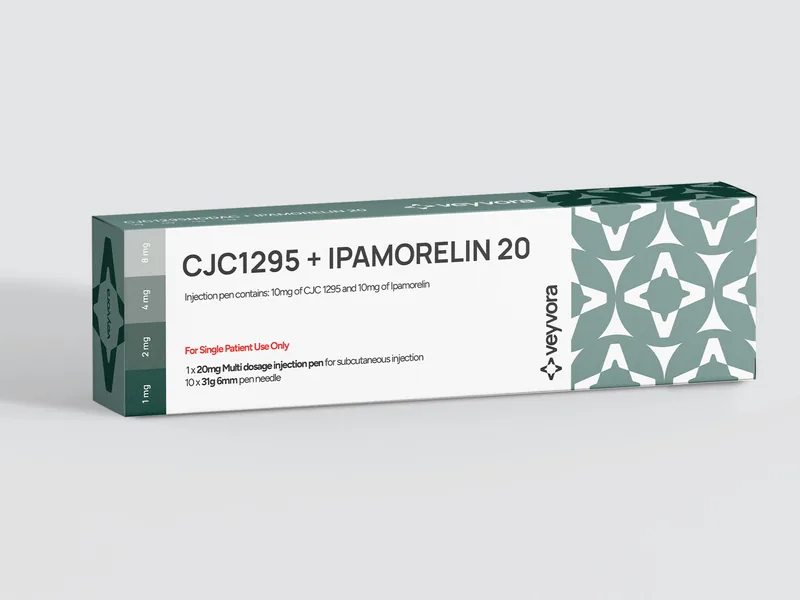
Because the two mechanisms are complementary, the research interest is in running them together — the reasoning behind the single CJC-1295 + Ipamorelin pen. If you want the GHRH arm on its own, tesamorelin isolates it.
verifying the blend
Because the pen supplies both compounds, the certificate of analysis should confirm the identity and proportion of each — see how to read a CoA. More on the class in the growth & recovery range.
research use only
Both compounds are supplied strictly for in-vitro and laboratory research use only — not medicines, not for human or veterinary consumption. Nothing here is dosing, medical or treatment guidance.
the research pens
Pre-filled, batch-numbered and independently assayed. Save one to your list and we'll email you the moment it's available in your country.
Overview
CJC-1295 and Ipamorelin are not interchangeable research materials: CJC-1295 is a GHRH analogue that targets the pituitary GHRH receptor, while Ipamorelin is a growth-hormone secretagogue that acts at GHS-R (the ghrelin receptor). Because the two compounds enter the growth-hormone axis at different receptor classes, substituting one for the other in an in-vitro assay does not preserve the receptor pathway under investigation. A paired research format is technically defensible only when a protocol genuinely requires both receptor pathways to be engaged simultaneously, not as a default configuration.
A second identity issue compounds the comparison: the label “CJC-1295” does not describe a single molecular entity. In the originating pharmacology literature, CJC-1295 denotes a DAC (Drug Affinity Complex) albumin-binding conjugate of modified GHRH(1–29). Merchant catalogues frequently apply the same name to the peptide without that albumin-binding group, sometimes calling it “CJC-1295 no DAC” or aligning it with modified GRF(1–29). These are materially different structures with different exact masses and different pharmacokinetic profiles in the original reports. Before any comparison is meaningful, the exact format must be confirmed against the certificate of analysis (CoA) for the batch in hand.
This comparison explains the receptor distinction between CJC-1295 and Ipamorelin, shows why DAC and non-DAC CJC-1295 must be separated, and sets out the batch documentation to check before procurement. To confirm current commercial terms or submit a purchase enquiry, use the checkout or enquiry path on the relevant Veyvora product page. All materials and discussion on this page are for laboratory and in-vitro research use only. No human treatment, administration or dosing information is provided or implied.
CJC-1295 vs Ipamorelin: The Short Verdict
CJC-1295 is a GHRH analogue that targets the pituitary GHRH receptor, while Ipamorelin is a selective GHRP that acts at GHS-R, the ghrelin receptor. Each compound enters the growth-hormone axis at a distinct receptor class, making the compounds mechanistically complementary research ligands rather than direct substitutes. Selecting between them depends on the assay question, the exact material identity confirmed by the certificate of analysis, and the quality of batch documentation.
A protocol investigating GHRH-receptor signalling requires a confirmed GHRH analogue; a protocol investigating GHS-R requires a confirmed GH-releasing peptide agonist such as Ipamorelin. Veyvora (2026) states that each batch is tested by Asterion Analytics, then again by Veyvora’s own internal testing, using HPLC, mass spectrometry and endotoxin assay, with assay purity reported at ≥98.0%, documentation that supports receptor-class verification before work begins. For a deeper explanation of why both pathway inputs may be studied in parallel, see the CJC-1295 + Ipamorelin research explainer.
Key Takeaways
- CJC-1295 engages GHRHR; Ipamorelin engages GHS-R, so the two materials answer different receptor questions.
- DAC and non-DAC CJC-1295 have different structures, masses and albumin-binding characteristics, so the format must appear clearly on the CoA.
- A defensible batch record includes mass-spectrometry identity, HPLC purity, peptide-content data, endotoxin data where relevant, and a matching batch number.
- A paired format belongs only in an assay designed to examine both receptor pathways independently.
What Is a GH-Releasing Peptide?
A GH-releasing peptide (GHRP) is a synthetic oligopeptide studied for its activity as a growth-hormone secretagogue, a compound that stimulates growth-hormone release through receptor-mediated pathways. In strict pharmacological usage, the term GHRP refers specifically to agonists of GHS-R (the ghrelin receptor), a receptor class distinct from the pituitary GHRH receptor targeted by GHRH analogues such as CJC-1295. Research catalogues sometimes apply the phrase loosely to any GH-axis peptide, which conflates two mechanistically separate receptor classes; that usage should be avoided in laboratory methods writing.
| Compound class | Primary receptor | Representative research ligand |
|---|---|---|
| GHRH analogue | Pituitary GHRH receptor (GHRHR) | CJC-1295 |
| GH-releasing peptide (GHRP) | Ghrelin receptor (GHS-R / GHSR-1a) | Ipamorelin |
The distinction matters for assay design: a protocol targeting GHRHR signalling requires a confirmed GHRH analogue, while a protocol targeting GHS-R requires a confirmed GHRP agonist. GHRP is a mechanism label derived from primary pharmacology literature; it is not a quality certificate, a regulatory category, or a human-use designation. Before accepting any material into a GH-axis assay, researchers should verify a batch against its certificate of analysis to confirm which receptor class the supplied sequence is designed to engage. Appropriate storage and stability guidance for research peptides should also be confirmed prior to use.
CJC-1295 Is a GHRH Analogue
CJC-1295 is classified as a GHRH analogue because its peptide backbone is a chemically modified fragment of human growth hormone-releasing hormone, specifically a tetrasubstituted GHRH(1–29) sequence designed to retain agonism at the pituitary GHRH receptor (GHRHR). That receptor-class designation is independent of whether the albumin-binding Drug Affinity Complex (DAC) moiety is present or absent.
DAC Versus Non-DAC: A Material Identity Issue
In the originating pharmacology literature, CJC-1295 names the DAC-bearing conjugate, in which a maleimidopropionyl group enables covalent binding to circulating albumin. Merchant catalogues have since applied the label “CJC-1295 without DAC” or “CJC-1295 no DAC” to the tetrasubstituted GHRH(1–29) peptide stripped of that moiety, a sequence more precisely aligned with modified GRF(1–29). The two formats share receptor-class intent but differ in molecular mass, covalent albumin-binding capacity and exact structure, and are not interchangeable in methods writing or batch ordering.
The label on a catalogue page is not sufficient to establish which format has been supplied. The certificate of analysis must be consulted before any material enters a GHRHR assay. A minimum specification checklist for batch acceptance should cover:
- Compound name as stated on the CoA
- Sequence or structural format where disclosed (DAC or non-DAC)
- DAC status confirmed against molecular-mass result
- Batch number matched to the CoA
- Molecular-mass result from mass spectrometry
- HPLC chromatographic purity result
- Endotoxin result where the assay system is endotoxin-sensitive
HPLC area-percent alone cannot confirm sequence identity; mass spectrometry is required as an orthogonal identity check [4]. Researchers working across the GHRH-analogue class may also find the tesamorelin as a GHRH analogue reference page useful for a mechanistic comparator, and the Growth & Recovery research catalogue provides a focused route to available GHRHR-targeted materials.
Ipamorelin Is a Selective GHRP
A selective GH-releasing peptide (selective GHRP) is a synthetic oligopeptide agonist of the ghrelin receptor (GHS-R, specifically the GHSR-1a subtype) that stimulates GH secretion with comparatively limited activity at other pituitary axes. Ipamorelin is classified within this ligand class on the basis of early pharmacology work, specifically Raun et al., European Journal of Endocrinology, 1998. That study reported GH secretagogue activity at GHS-R with less concomitant ACTH/cortisol and prolactin signal than GHRP-6 in the experimental systems examined, and described ipamorelin as the first selective growth-hormone secretagogue. That characterisation is a receptor-class and relative-selectivity descriptor for those specific assay conditions; it is not a warranty of selectivity in every in-vitro matrix or across every commercial lot.
What Selectivity Does and Does Not Mean for Laboratory Work
Selectivity, as used in the GHRP literature, describes a ligand’s relative preference for GHS-R over other pituitary receptors in a defined experimental system. Selectivity does not describe the purity, sequence identity or endotoxin status of any particular research-chemical batch. Material labelled “ipamorelin” may carry the correct sequence at high HPLC purity and still require orthogonal mass-spectrometry confirmation before the material can be attributed to GHS-R activity in an assay; see what HPLC purity does and does not prove for the methodological limits of area-percent data [4].
Ipamorelin acts through GHS-R, whereas CJC-1295 targets the GHRH receptor (GHRHR). Substituting one for the other does not preserve receptor identity in a GHRHR or GHS-R assay; the two compounds are mechanistically complementary, not interchangeable. The CJC-1295 + Ipamorelin research explainer covers the rationale for studying both receptor inputs in parallel.
CJC-1295 vs Ipamorelin Comparison Table
CJC-1295 and Ipamorelin are mechanistically complementary research peptides, not interchangeable alternatives: CJC-1295 is a GHRH analogue acting at the GHRH receptor (GHRHR), while Ipamorelin is a selective GHRP acting at the ghrelin receptor (GHS-R), placing the two compounds at distinct entry points on the growth-hormone axis.
| Criterion | CJC-1295 (DAC form) | CJC-1295 (non-DAC / modified GRF 1–29) | Ipamorelin |
|---|---|---|---|
| Peptide class | GHRH analogue | GHRH analogue | Selective GHRP |
| Principal receptor / pathway | GHRHR | GHRHR | GHS-R (GHSR-1a) |
| Defining structural feature | Tetrasubstituted GHRH(1–29) + albumin-binding DAC moiety | Tetrasubstituted GHRH(1–29); no DAC | Pentapeptide GH secretagogue |
| Format ambiguity risk | Low, DAC conjugate is the literature entity | High, “CJC-1295 no DAC” is market terminology, not the named literature compound | Low, single well-described sequence |
| Selectivity terminology | GHRHR agonist; no “selective GHRP” descriptor applies | GHRHR agonist | Described as the first selective growth-hormone secretagogue (Raun et al., 1998; assay-dependent) |
| Evidence maturity | Primary pharmacology papers from 2005–2006 (stale); no 2024–2026 peer-reviewed update verified | Shares receptor class with DAC form; independent evidence base is thinner | Primary in-vitro and animal data from 1998 (stale); no 2024–2026 peer-reviewed update verified |
| Material-identification risk | Moderate, exact mass and covalent albumin-binding group must match CoA | High, name overlaps with DAC form in catalogues; sequence and mass must be confirmed against certificate of analysis | Moderate, sequence is short and well-characterised; mass-spectrometry confirmation still required |
| Suitable in-vitro question | GHRHR binding, receptor activation, GHRHR-pathway assays | GHRHR-pathway assays where DAC albumin-binding is not required | GHS-R binding, receptor activation, GHS-R-pathway assays |
| Minimum documentation required | CoA with HPLC purity, mass-spectrometry identity, endotoxin result, batch number | CoA with HPLC purity, mass-spectrometry identity, endotoxin result, batch number; sequence must be stated explicitly | CoA with HPLC purity, mass-spectrometry identity, endotoxin result, batch number |
Reading the Table Correctly
Receptor classification is a literature descriptor for a defined molecular entity; it does not replace identity testing on the specific vial in hand. Before accepting any batch, verify the batch number against its certificate of analysis and confirm that the stated sequence, molecular mass and purity meet your protocol’s acceptance criteria. For cold-chain requirements that affect material integrity before the CoA is even consulted, see storage and stability guidance for research peptides.
When Does a Paired Format Make Sense?
A paired CJC-1295 and Ipamorelin format is technically defensible only when the research protocol is explicitly designed to examine activity across both the GHRH-receptor (GHRHR) pathway and the ghrelin-receptor (GHS-R) pathway simultaneously, and when each compound’s identity has been independently confirmed against its own certificate of analysis before the experiment begins.
Decision Rules for Protocol Design
The choice of format should follow the receptor question, not catalogue convention:
- GHRHR pathway in isolation: use CJC-1295 (DAC or non-DAC, specified precisely) as the sole ligand. For a well-characterised GHRH-analogue comparator with a distinct structural profile, the tesamorelin research page provides a useful reference point.
- GHS-R pathway in isolation: use Ipamorelin as the sole ligand. Introducing a GHRHR agonist alongside Ipamorelin conflates two mechanistically distinct inputs and complicates attribution of any observed signal.
- Combined pathway activity: a paired format is appropriate when the assay system, for example primary pituitary cultures expressing both GHRHR and GHS-R, requires stimulation of both receptors as independent variables. The protocol must state which receptor each compound addresses and must not treat the pairing as a single composite treatment.
No synergy claim or predictable combined outcome follows from the mechanistic complementarity of these two ligand classes. Researchers designing dual-pathway assays can find a deeper mechanism discussion in Veyvora’s CJC-1295 and Ipamorelin research explainer.
The Verification Matrix Competitors Usually Omit
A mechanistically attractive compound is not a defensible research choice when the material in hand cannot be independently verified. The table below scores the criteria that determine whether a batch of CJC-1295 or Ipamorelin is fit for reproducible in-vitro work, criteria that catalogue descriptions and outcome-led marketing routinely omit.
| Verification criterion | What to require | Why HPLC alone is insufficient |
|---|---|---|
| Molecular identity | Mass spectrometry confirming the correct molecular mass for the stated format (DAC or non-DAC for CJC-1295; pentapeptide mass for Ipamorelin) | HPLC area-percent confirms chromatographic purity relative to observed peaks; it cannot confirm the correct sequence or distinguish a structurally similar impurity [4] |
| Chromatographic purity | Batch-specific HPLC result with stated threshold | Purity is relative to detected peaks only; non-chromophoric counter-ions and water content are invisible to HPLC [4] |
| Peptide content / concentration | Separate quantitative assay (e.g. amino-acid analysis or calibrated content method) | HPLC purity is not a concentration figure [4] |
| Endotoxin | LAL or equivalent result, particularly where the assay system is endotoxin-sensitive | Endotoxin is a distinct test; no HPLC result carries endotoxin data [4] |
| Independent laboratory testing | Results from at least two separate laboratories per batch | Single-laboratory results cannot exclude systematic error or instrument bias |
| Batch-number traceability | CoA batch number matches the pen label and dispatch documentation | A generic CoA not tied to a specific batch number does not authenticate the material received |
| Synthesis-partner disclosure | Supplier identifies the synthesis partner where disclosure is permitted | Reseller identity and manufacturer identity are distinct; a reseller’s quality claim is only as strong as its supply-chain controls |
| Cold-chain evidence | Dispatch under documented cold-chain conditions in an insulated bag with a gel ice pack | Peptide degradation during transit is invisible without a physical temperature record |
How Veyvora’s Stated Controls Map to This Matrix
Veyvora’s batch documentation (2026) states that each batch is tested by Asterion Analytics, then again by Veyvora’s own internal testing, using HPLC, mass spectrometry and endotoxin assay, with an assay-purity threshold of ≥98.0%. Orders are stated to be dispatched within 24 hours under documented cold-chain conditions in an insulated bag with a gel ice pack. Every pen ships with an independent, batch-specific certificate of analysis, with the batch number matched to that certificate at the point of dispatch. Veyvora also discloses synthesis-partner detail for a batch where the supply agreement permits, so its stated controls map across the verification matrix above.
ICH Q6B frames identity, purity and quantity as separate specification elements [4]; a CoA that conflates them, or that quotes only an HPLC area-percent figure, does not satisfy all three. Veyvora’s CJC-1295 + Ipamorelin research explainer covers the dual-pathway rationale in more depth, and the dedicated page on what HPLC purity does and does not prove resolves the next practical question once a CoA is in hand.
Research Use Only: What the Label Means
CJC-1295, Ipamorelin and all related GH-axis research peptides supplied by Veyvora are intended strictly for in-vitro laboratory research use only. They are not medicines, not authorised for human or veterinary administration, and the “research use only” label does not confer any medicinal status or regulatory approval.
In the UK, a product presented as treating or preventing disease is a medicinal product under the Human Medicines Regulations 2012 and requires MHRA authorisation [1][2]. A reagent labelled solely for laboratory and in-vitro research use, and supplied without medicinal claims, sits outside that authorisation pathway, but only where the reagent is genuinely used that way. Labelling alone does not legalise medicinal supply. EU distributors must verify whether presentation triggers Directive 2001/83/EC and whether the substance falls under REACH and CLP classification [3]. South African buyers should confirm SAHPRA status under the Medicines and Related Substances Act 101 of 1965 before importing or reselling; the applicable route for unregistered material requires independent verification with SAHPRA directly.
Pre-Order Compliance Checklist for Buyers and Distributors
Before placing an order, confirm each of the following:
- Intended application is documented as in-vitro laboratory research, not human or veterinary use
- Institutional ethics or biosafety controls are in place and recorded
- COSHH risk assessment and HSE handling controls are completed for the specific peptide
- Local import classification and any required permits have been verified for the destination country
- Resale or redistribution terms comply with the jurisdiction’s requirements for research-use-only materials
- Batch documentation, including the certificate of analysis, is retained for audit purposes
- No medicinal claims will be made in any downstream communication
Once material is received, verify a batch against its certificate of analysis before use, and consult storage and stability guidance for research peptides to confirm cold-chain conditions are maintained from receipt onwards.
Current Price, Availability and Purchase Route
Current price, stock and eligible delivery markets for the CJC-1295 + Ipamorelin research pen are shown on Veyvora’s live product and checkout pages; take commercial terms from there rather than from this article. Veyvora states that research-peptide orders are dispatched within 24 hours under documented cold-chain conditions in an insulated bag with a gel ice pack.
For laboratories selecting a research domain, the Growth & Recovery research catalogue provides a focused route to relevant products. Researchers requiring a GHRH-only comparator for protocol design may find the tesamorelin as a GHRH analogue page useful before finalising material selection.
To view current availability, pricing and the approved purchase or wholesale enquiry route, visit the relevant product page on Veyvora’s site. All materials are supplied for laboratory and in-vitro research use only.
Questions Laboratories Should Resolve Before Ordering
Before selecting CJC-1295, Ipamorelin or a paired format, a laboratory should confirm molecular identity, batch documentation, regulatory status and cold-chain integrity. The answers below address the questions most likely to affect protocol reproducibility and procurement decisions.
Are CJC-1295 and Ipamorelin the Same Type of Peptide?
No. CJC-1295 is a GHRH-receptor agonist analogue; Ipamorelin is a GHS-R agonist. They act through different receptors on the growth-hormone axis and are mechanistically complementary, not interchangeable. Substituting one for the other does not preserve receptor identity in an in-vitro assay.
What Is a GHRH Analogue?
A GHRH analogue is a synthetic peptide designed to activate the pituitary GHRH receptor (GHRHR), mimicking the action of endogenous growth-hormone-releasing hormone. CJC-1295 is a tetrasubstituted analogue of human GHRH(1–29); the DAC-bearing version additionally binds circulating albumin to extend exposure in experimental systems.
What Is a Selective GHRP?
A GH-releasing peptide (GHRP) is a synthetic oligopeptide agonist of the ghrelin receptor (GHS-R). Ipamorelin is described in the primary literature as a selective GHRP because early experimental data indicated GH secretagogue activity at GHS-R with comparatively less stimulation of ACTH/cortisol and prolactin than earlier GHRPs. Selectivity is assay- and species-dependent and is not a warranty for every in-vitro matrix or commercial lot.
Does CJC-1295 DAC Differ From Non-DAC Material?
Yes, materially. In the primary pharmacology literature, CJC-1295 denotes the albumin-binding DAC conjugate of modified GHRH(1–29). Merchant catalogues have also labelled tetrasubstituted GHRH(1–29) without the DAC moiety as “CJC-1295 no DAC.” These are structurally distinct materials; always confirm the exact format against the certificate of analysis before use.
Does HPLC Alone Prove Identity?
No. HPLC area-percent supports chromatographic purity relative to observed peaks; it does not confirm the correct amino-acid sequence, absolute peptide content or endotoxin status [4]. Identity requires orthogonal confirmation, at minimum mass spectrometry. The what HPLC purity does and does not prove page sets out where the method’s limits lie.
What Evidence Should a Laboratory Require Before Accepting a Batch?
Require a batch-specific certificate of analysis covering: mass-spectrometry identity, HPLC chromatographic purity, a separate peptide-content or amino-acid-analysis result, stated sequence and counter-ion, and a bacterial endotoxin result when the in-vitro system is endotoxin-sensitive [4]. The batch number on the pen label must match the CoA exactly.
What Does Research Use Only Mean?
In the UK, a product presented for treating or preventing disease is a medicinal product under the Human Medicines Regulations 2012 and requires MHRA authorisation [1][2]. A reagent labelled solely for laboratory and in-vitro research use, and not presented with medicinal claims, sits outside that authorisation pathway, though the label does not legalise medicinal supply. EU distributors must verify REACH/CLP classification and Directive 2001/83/EC presentation rules [3]; South African distributors should confirm SAHPRA status under the Medicines and Related Substances Act 101 of 1965 before import or resale.
For a deeper explanation of why the two receptor pathways may be studied in parallel, the CJC-1295 + Ipamorelin research explainer provides the mechanistic context this comparison page does not repeat. To confirm current availability and the approved purchase route, visit the relevant product page on Veyvora’s site directly. All materials are supplied for laboratory and in-vitro research use only.
Sources
[1] The Human Medicines Regulations 2012, legislation.gov.uk, https://www.legislation.gov.uk/uksi/2012/1916/contents [2] The Human Medicines Regulations 2012, regulation 46 (need for a marketing authorisation), legislation.gov.uk, https://www.legislation.gov.uk/uksi/2012/1916/regulation/46 [3] REACH Regulation - European Commission, environment.ec.europa.eu, https://environment.ec.europa.eu/topics/chemicals/reach-regulation_en [4] ICH Q6B specification principles (analytical review), pmc.ncbi.nlm.nih.gov, https://pmc.ncbi.nlm.nih.gov/articles/PMC5830484/