

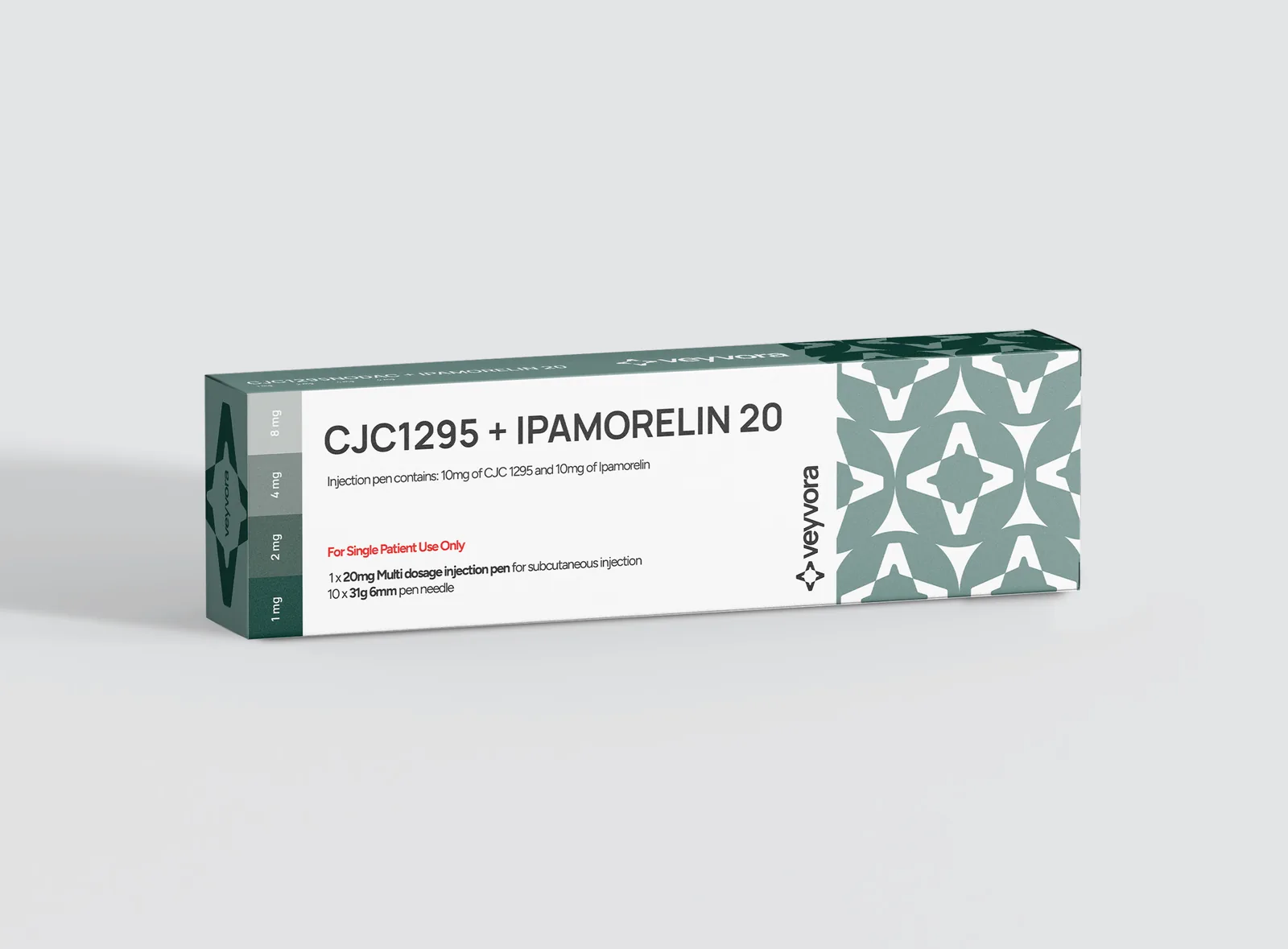
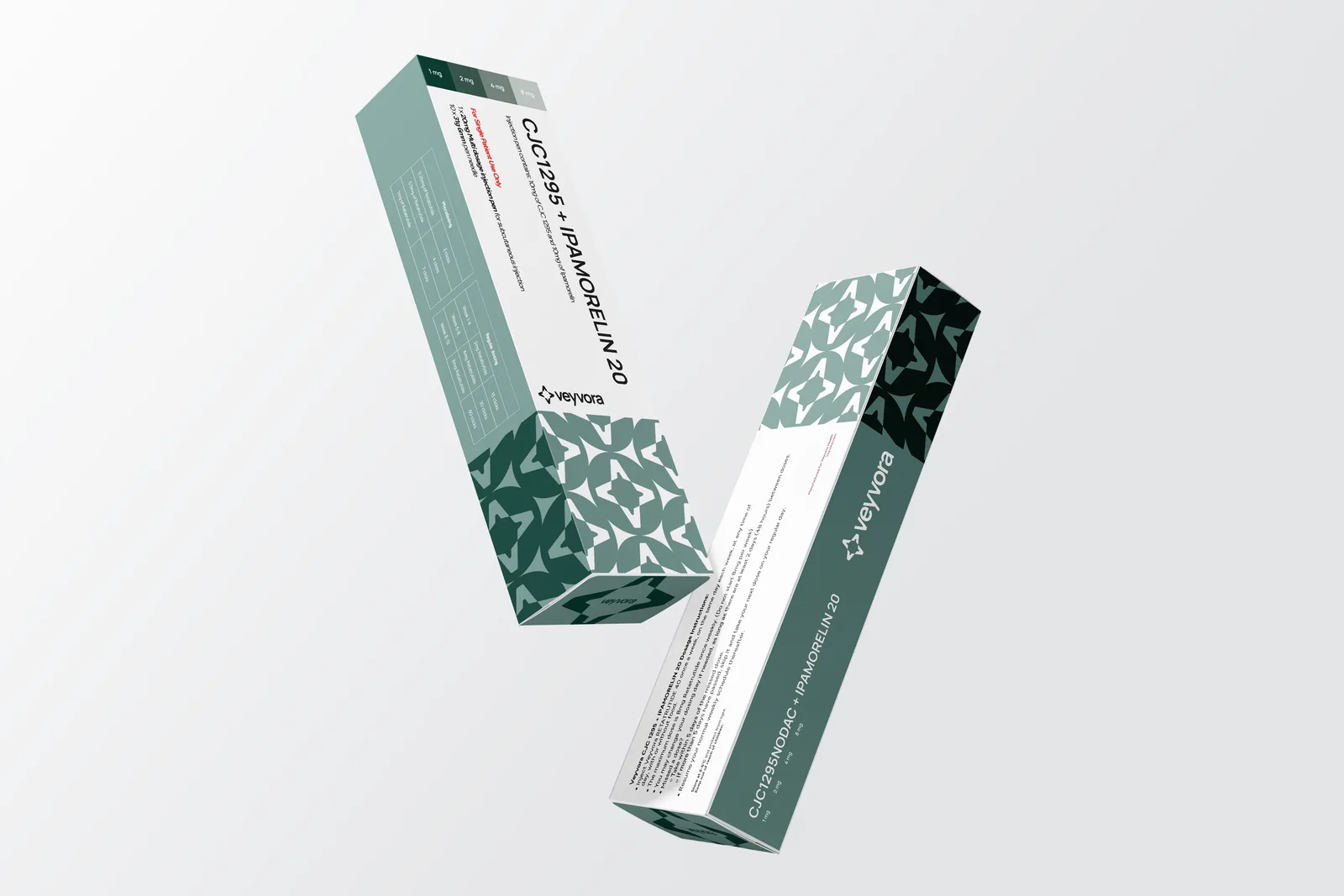
CJC-1295 + Ipamorelin 20
A growth-hormone secretagogue blend of CJC-1295 and Ipamorelin in a single 20 mg click pen. Each click delivers 67 µg from a 3 mL · 300-click pen.
Featured in these stacks: Recovery Stack, Advanced Growth Stack.


how many clicks
for your dose?
This CJC-1295 + Ipamorelin 20 pen holds 20 mg across 300 clicks, so each click delivers 67 µg. Tap a dose or turn the dial; we'll count the clicks. For research reference only.
why researchers chose this pen
chose it for the click dosing, no syringes, no unit maths.
verified purity, checked against the public CoA before first use.
precise clicks in every 3 mL pen, the whole protocol in one barrel.
re-order or refer a colleague within three months.
about the
CJC-1295 + Ipamorelin 20 pen
A paired growth-hormone secretagogue pen combining CJC-1295 with Ipamorelin, supplied in a 3 mL / 300-click pen for research. (Placeholder price, pending confirmation.)
Certificate of analysiswhy a pen beats
a vial & syringe
Traditional research peptides arrive as lyophilised powder that must be reconstituted, drawn into insulin syringes, and converted from milligrams to units by hand, every step a chance for a dosing error.
A multi-dose pen removes the whole failure chain. The peptide arrives already dissolved and calibrated. Attach a fresh needle, turn the dial until you count your clicks, and you're done, the same audible-click mechanism trusted in insulin and GLP-1 pens worldwide.
Pens travel and store better, too: no open vials, no bent needles, no septum contamination after repeated draws. One sealed barrel, ten sterile needles, one dosing card.
how to buy
peptides safely
The peptide market has a purity problem: independent surveys routinely find underdosed, mislabelled or contaminated product sold online. The only reliable defence is third-party verification you can check yourself, not a supplier's own claims.
Before buying any peptide pen, ask three questions. Is every batch tested by an independent lab? Is the certificate of analysis available, so you can check your exact lot before first use? And does it ship cold-chain, insulated and gel-packed, so what was tested is what arrives?
Veyvora answers yes on every order, independent assay, a CoA on request against the batch number, and cold dispatch within 24 hours, paperwork packed inside.
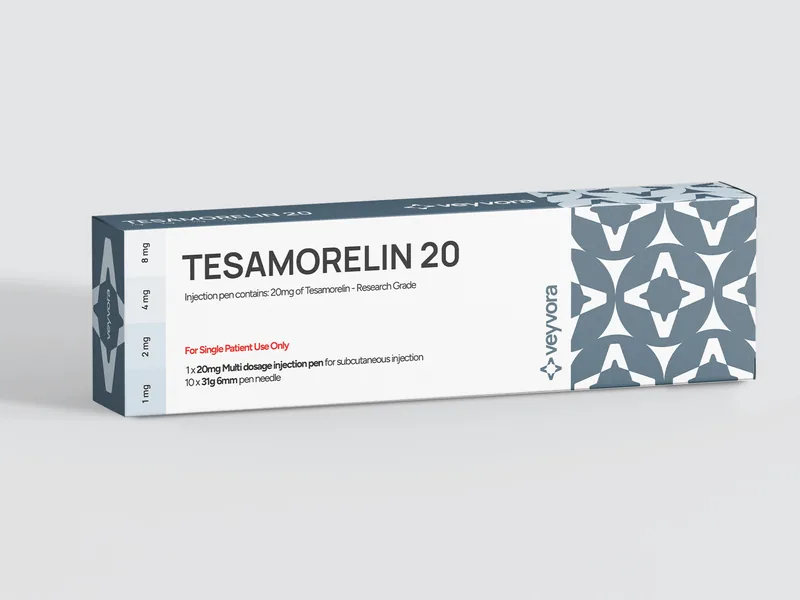
pairs well with
view all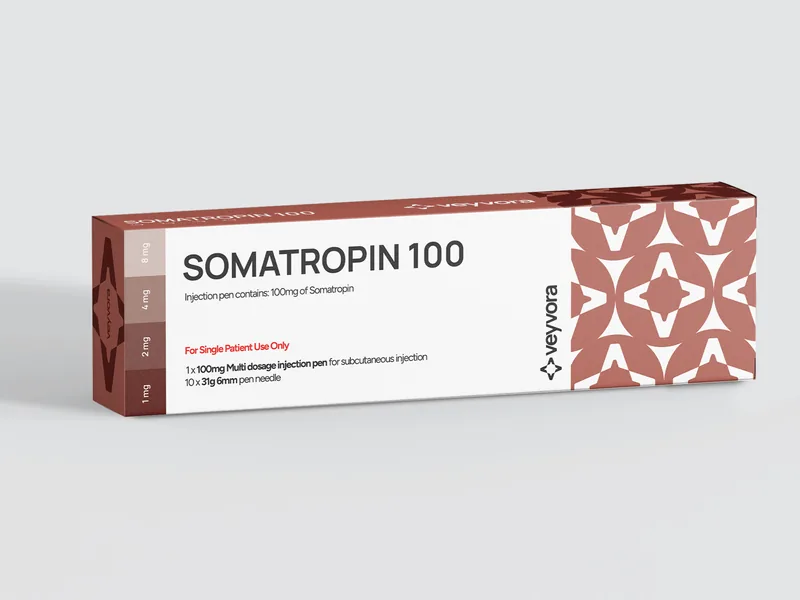
Overview
The Veyvora CJC-1295 + Ipamorelin pen contains 20 mg of combined peptide across 300 clicks, delivering approximately 67 micrograms per click, and is supplied strictly for in-vitro laboratory use, not as an MHRA-authorised human medicine (Veyvora product specification, 2026). No combination product of this type appears on the MHRA’s UK authorised medicines register as a licensed human medicine [1]. Purchase in the United Kingdom is restricted to bona fide laboratory and distributor contexts.
| Specification | Veyvora Stated Value (2026) |
|---|---|
| Total peptide content | 20 mg |
| Volume | 3 mL |
| Clicks per pen | 300 |
| Peptide per click | ~67 micrograms |
| Presentation | Multi-dose research pen |
| Intended use | In-vitro research only |
Current GBP pricing, stock status and purchase path are merchant-specific figures that must be confirmed directly on the dated Veyvora en-GB product page at the time of ordering; no price is reproduced here because any figure not pulled from a live, dated listing would be unverified. Veyvora states that each batch is tested by two independent laboratories using HPLC, mass spectrometry and endotoxin assay, with a public certificate of analysis available to check against the batch number before first use (Veyvora quality documentation, 2026).
Product Identity and Scope
The Veyvora CJC-1295 + Ipamorelin pen is a multi-dose research reagent containing 20 mg of combined peptide across 300 clicks, delivering approximately 67 micrograms per click, supplied strictly for in-vitro laboratory use and not as an MHRA-authorised human medicine (Veyvora product specification, 2026).
CJC-1295 and ipamorelin are distinct molecules. CJC-1295 is a tetrasubstituted GHRH(1–29) analogue available in two non-equivalent forms: with Drug Affinity Complex (DAC) and without DAC, the latter often labelled Mod GRF 1–29. Ipamorelin is a selective ghrelin-receptor agonist pentapeptide. The label must state which CJC-1295 form is present, as the two are not interchangeable in a research protocol.
No combination product of this type appears on the MHRA’s UK authorised medicines register as a licensed human medicine [1]. Purchase in the United Kingdom is restricted to bona fide laboratory and distributor contexts, with intended use confined to in-vitro protocols. Before first use, the lot number on the pen must match the certificate of analysis; the workflow for that check is covered in how to match a batch to its CoA.
Verified Specifications
The Veyvora CJC-1295 + Ipamorelin pen contains 20 mg of combined peptide across 300 clicks, delivering approximately 66.7 micrograms per click, displayed on the device as 67 micrograms per click (Veyvora product specification, 2026). Veyvora supplies the pen as a multi-dose injector in a ready-to-use solution; fill volume and solvent composition should be confirmed against the current en-GB product listing before ordering, as these values are not independently verified in this article.
CJC-1295 Ipamorelin Dosage: Count the Clicks
Each click of the Veyvora CJC-1295 + Ipamorelin pen delivers approximately 66.7 micrograms of combined peptide, displayed as 67 micrograms per click (Veyvora product specification, 2026). For in-vitro laboratory research use only, calculate the number of clicks required for a target quantity as: clicks = target micrograms ÷ 66.7 micrograms. The pen contains 300 clicks in total across 20 mg of combined peptide.
Composition and Format
| Parameter | Stated value | Source |
|---|---|---|
| Total peptide content | 20 mg | Veyvora product specification, 2026 |
| Total clicks per pen | 300 | Veyvora product specification, 2026 |
| Peptide per click | ~66.7 µg (displayed as 67 µg) | Veyvora product specification, 2026 |
| CJC-1295 form (DAC or no-DAC) | Confirm with operator | — |
| Fill volume (mL) | Confirm with operator | — |
| Salt form | Confirm with operator | — |
The label must explicitly state whether the CJC-1295 component is the DAC or no-DAC (Mod GRF 1–29) form; the two carry different molecular weights and published pharmacokinetic profiles and are not interchangeable in a research protocol. HPLC confirms purity and mass spectrometry confirms identity. For what HPLC purity figures do and do not establish, see what HPLC purity does and does not prove. Device marking status (UKCA or CE) is a separate declaration and should be requested from Veyvora directly before procurement.
Batch Documentation and Analytical Evidence
A certificate of analysis is only valid evidence when the lot number on the pen, the outer carton and the CoA are identical, and the document names the correct peptide sequences, the testing laboratory, the analytical method and the date of analysis. Veyvora states that each batch is tested by two independent laboratories using HPLC, mass spectrometry and an endotoxin assay, with a public certificate of analysis to check against the batch number before first use (Veyvora quality documentation, 2026). That statement is authoritative about Veyvora’s stated policy; reading the actual CoA for the specific lot in hand remains necessary.
CJC-1295 Ipamorelin Reviews and Buyer Evidence
Genuine buyer evidence in CJC-1295 ipamorelin reviews must reference a public certificate of analysis matched to a specific lot number, a named testing laboratory, and a temperature indicator result from the inbound shipment. Veyvora publishes a public certificate of analysis for each batch, which buyers should retrieve and verify against the batch number on the pen before first use (Veyvora quality documentation, 2026). Forum screenshots, marketplace purity badges and undated PDFs with no named laboratory are not analytical evidence.
What Each Test Result Can and Cannot Prove
HPLC purity figures confirm the proportion of the target peptide peak relative to detected impurities under the stated chromatographic conditions; they do not confirm absolute identity. Mass spectrometry establishes molecular identity by confirming the correct mass-to-charge ratio for each peptide sequence. An endotoxin assay, where claimed, must specify the method (LAL or recombinant factor C) and the limit applied.
A supplier that cannot provide a lot-matched CoA before dispatch leaves any purity or potency claim for that pen uncitable. Prefer reports from a UKAS-accredited ISO/IEC 17025 laboratory where available; confirm accreditation status directly with the supplier at the time of ordering.
Handling and Storage
Veyvora states that the CJC-1295 + Ipamorelin pen is dispatched in insulated, gel-packed 2–8 °C packaging with a temperature indicator strip; confirm current dispatch timelines, availability and exact delivery terms directly with Veyvora before ordering, as those figures are operator-verified at the time of purchase (Veyvora handling specification, 2026).
What the Cold-Chain Record Must Show
A gel-pack photograph is not a temperature record. For any refrigerated peptide reagent, inbound documentation should include a continuous temperature log or a calibrated indicator strip result, retained against the labelled storage range of 2–8 °C. Distributors operating under UK Good Distribution Practice expectations should keep those inbound records on file.
Reconstituted Solution Versus Lyophilised Material
Lyophilised and reconstituted peptide solutions have different stability profiles and must not be treated interchangeably. Reconstitution solvent, in-use period and photostability are batch- and formulation-specific values that belong on the product insert or CoA for the specific lot in hand. Where those values are absent from the documentation supplied with a pen, treat them as unverified and request clarification from the supplier before first use. Freeze-thaw cycling of a reconstituted solution is a documentation gap, not an established shelf-life extension. For the prerequisite workflow before opening any pen, see how to match a batch to its CoA.
Ordering Information
No verified GBP price, current stock level, minimum order quantity, courier service-level agreement or import-clearance timeline for the Veyvora CJC-1295 + Ipamorelin pen appears in this article; those figures are merchant-specific and must be confirmed directly from the dated Veyvora product page at the time of purchase. Any £ figure or “in stock” claim not drawn from a live, dated 2026 listing is unverified and has been omitted here.
What to Confirm Before Placing an Order
When ordering for laboratory or distributor use, capture the following as contract terms rather than assuming them from marketing copy:
- Legal entity name and registered delivery address
- Declared intended use (in-vitro laboratory research only)
- Lot reservation and CoA-before-dispatch confirmation
- Cold-chain packing specification and temperature indicator strip inclusion
- VAT treatment and customs commodity code applicable to the shipment
- DAC or no-DAC status of the CJC-1295 component
Regulatory and Import Considerations
Border Force or the MHRA may detain imports of unlicensed peptides into Great Britain where products are presented as medicines or intended for human use [1]. Research-only labelling does not automatically legalise supply; the Human Medicines Regulations 2012 govern how a product is presented, not only how it is labelled [1]. Whether the injector is declared as a medical device or a laboratory chemical is a live commercial question for the named seller. For storage requirements that apply from the moment the pen arrives, see research-peptide storage and stability guidance. Researchers whose protocol requires a different blend or format can review the Growth & Recovery research pens catalogue for alternatives.
Research-Use-Only Limitations
In the United Kingdom, a product presented for treating or preventing disease, or for administration to humans for a medicinal purpose, is regulated as a medicine under the Human Medicines Regulations 2012 [1]. The Veyvora CJC-1295 + Ipamorelin pen carries no MHRA marketing authorisation for human use; supplying it as an unlicensed medicine can constitute a criminal offence under those Regulations [1].
“Research use only” labelling does not automatically legalise supply. The Human Medicines Regulations 2012 govern how a product is presented, not only how it is labelled [1]; marketing copy that references body composition, recovery or anti-ageing outcomes may be sufficient to bring a product within the medicines definition regardless of the label [2].
For laboratory researchers, lawful use is confined to bona fide in-vitro protocols. Prospective distributors must not imply human injection, reproduce click-dose schedules as administration guidance, or rely on athlete testimonials as quality evidence. Before placing an order, confirm the intended-use declaration in writing with the named seller.
Related Research and Comparison Pages
The distinction between CJC-1295 with DAC and without DAC (Mod GRF 1–29) is a molecular one with documented half-life differences in published pharmacology; a pen labelled “CJC-1295” without specifying DAC status is an incomplete specification. A lyophilised vial and a multi-dose pen are not interchangeable presentations for laboratory protocols, and their documentation requirements differ.
For the molecular distinction between the two active peptides in this pen, see CJC-1295 versus Ipamorelin explained.
Marketplace reviews, athlete testimonials and forum threads are not comparison sources for laboratory procurement. Where they describe human injection, they document unauthorised use rather than product performance [1].
To proceed: locate the batch number on the pen and outer carton, retrieve the matching certificate of analysis from Veyvora’s documentation portal, and confirm lot identity before first use.
Sources
[1] Human Medicines Regulations 2012, legislation.gov.uk, https://www.legislation.gov.uk/uksi/2012/1916/contents
[2] Human Medicines Regulations 2012, body provisions, legislation.gov.uk, https://www.legislation.gov.uk/uksi/2012/1916/body/data.xht?view=snippet&wrap=true